Pit bull temperament reflects genetics, early development, learning, health, and daily surroundings. A breed label cannot tell you whether a particular dog will be safe in your household, and affection alone cannot provide the training or supervision a strong dog needs. Few dogs inspire as many different reactions as the pit bull. To some people, these muscular, energetic dogs are affectionate companions. To others, their strength and history raise serious safety concerns.
Both perspectives deserve a practical answer: What shapes the behavior of the dog in front of you? Understanding inherited tendencies alongside that dog’s experiences offers more useful guidance than labeling an entire group dangerous or harmless. Pit bull-type dogs can build close family relationships and learn impressive skills. They can also present significant challenges when their strength or responses to other animals are underestimated. Responsible ownership begins by recognizing both possibilities.
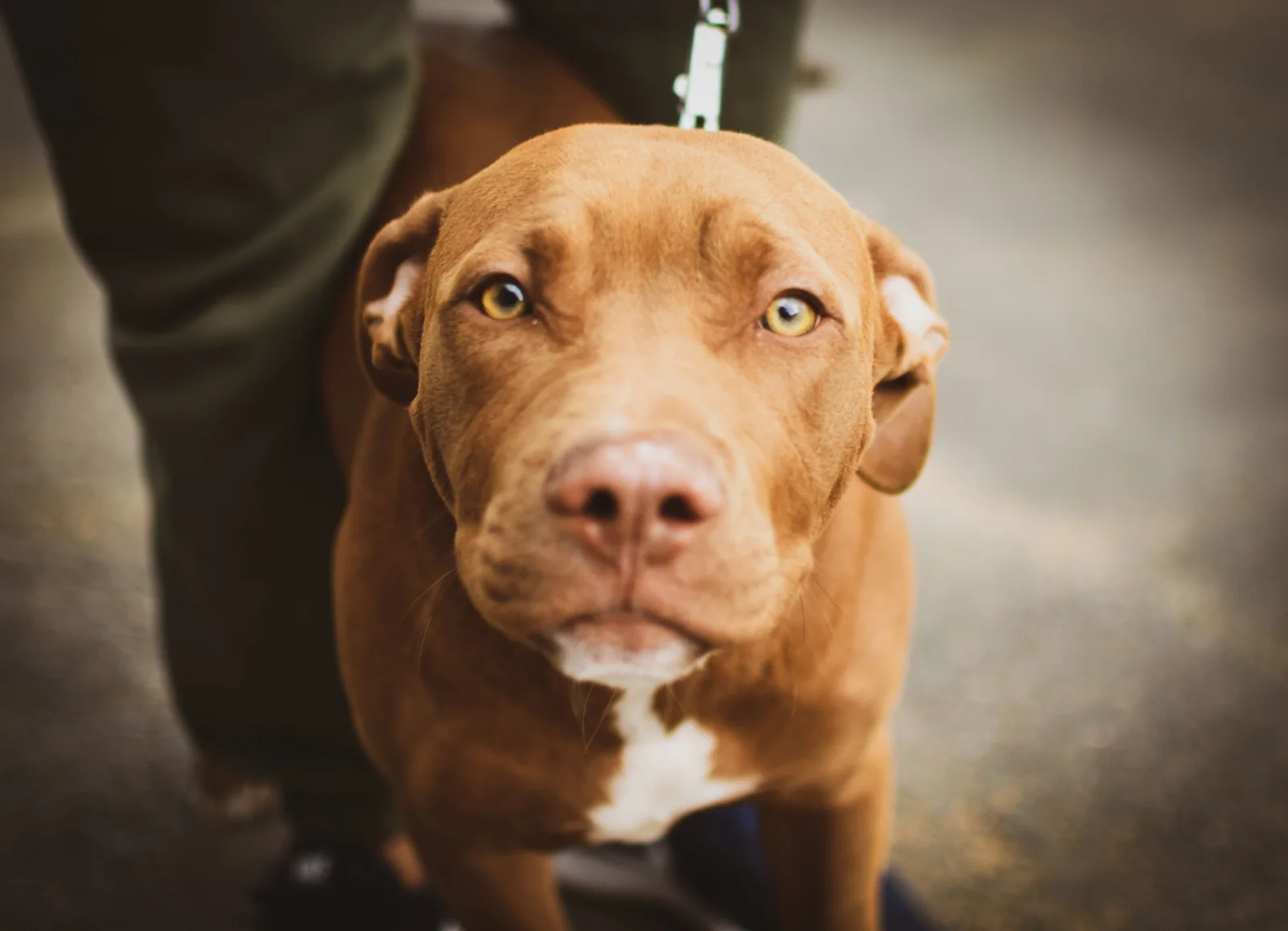
What Is a Pit Bull, Exactly?
Before discussing temperament, there is an important distinction to understand: pit bull does not always refer to one specific breed. The American Pit Bull Terrier is a recognized breed registered by the United Kennel Club (UKC). However, throughout the United States, the term pit bull is frequently used for several related breeds and mixed-breed dogs with similar physical characteristics.
| Breed | Registry distinction | Physical context |
|---|---|---|
| American Pit Bull Terrier | Recognized by UKC since 1898 | Medium-sized, athletic terrier; balance rather than exaggerated bulk |
| American Staffordshire Terrier | Distinct AKC breed | About 17–19 inches at the shoulder |
| Staffordshire Bull Terrier | Distinct AKC breed | About 14–16 inches at the shoulder |
| American Bully | Separately recognized by UKC in 2013 | Compact, substantial build; several size categories |
Mixed-breed dogs with similar appearances may receive the same umbrella label. The table distinguishes registry categories, not levels of safety or guarantees about personality. Although these dogs share some ancestry or physical traits, they are not interchangeable. Visual appearance creates another complication. A broad head, short coat, and muscular body do not necessarily reveal a dog’s genetic ancestry. A 2015 study of 120 shelter dogs found inconsistent visual identification of pit bull-type dogs among staff and against the study’s DNA-based classifications.
This distinction becomes especially important when discussing behavioral studies, bite statistics, housing restrictions, or breed-specific legislation. When someone describes a dog as a pit bull, it is worth asking whether they mean a registered American Pit Bull Terrier or a dog identified by appearance.

The History Behind the Pit Bull’s Reputation
During the nineteenth century, breeders in Britain developed bull-and-terrier dogs by combining characteristics associated with bulldogs and terriers. Strength, athleticism, determination, and physical endurance were among the qualities valued in these early dogs. Some were unfortunately bred and exploited for animal fighting. That history cannot be ignored, particularly when examining the development of certain working traits and behavioral tendencies.
After arriving in the United States, dogs from these lines also served in different roles, including farm work, hunting-related activities, and companionship. Some became beloved family companions. Others were exploited by people involved in illegal dogfighting or irresponsible breeding. Yet historical selection alone cannot tell us how an individual dog will behave today. A dog’s ancestry may provide useful information about potential tendencies, but it does not replace a careful assessment of the animal standing in front of us.
How Genetics Influence Pit Bull Temperament
Every dog inherits more than physical characteristics from its parents. Genetics can contribute to behavioral traits involving activity level, motivation, sensitivity, sociability, and responses to particular situations. Selective breeding can influence the frequency of certain tendencies within a population. For pit bull-type dogs, historical selection is relevant when discussing athletic ability, persistence, and the possibility of dog-directed aggression in some individuals.
However, genetic influence is not the same as behavioral certainty. A dog may inherit a tendency without expressing it in every environment or situation. Another dog with similar ancestry may behave differently because of its individual genetic makeup, developmental experiences, training, or health.
What Does Scientific Research Tell Us?
Morrill and colleagues, publishing in Science in 2022, surveyed owners of 18,385 dogs and genotyped 2,155 dogs. The researchers found that many behavioral characteristics were heritable, but breed explained about 9% of individual behavioral variation across the measures studied. That finding does not mean genetics are unimportant—or that the remaining 91% is simply training. Unexplained variation cannot all be assigned to a single cause.
Instead, it highlights how difficult it is to predict an individual dog’s personality from a breed label alone. The study also examined behavioral tendencies across many breeds and traits. It did not calculate a pit bull’s probability of biting or the severity of a future injury. Owner questionnaires and a volunteer sample also limit how far the results can be generalized.
Research can also ask a different question: how do breed averages relate to genetic differences? A 2019 study by MacLean and colleagues found substantial heritable differences among breed averages. That does not contradict variation within a breed: a group tendency is not an individual forecast. For owners and prospective adopters, consider ancestry and family history alongside the dog’s observed behavior. A lineage is a family line within a breed; ancestry describes genetic origins; a shelter label may be an appearance-based guess. None is interchangeable with a behavioral assessment.
How Upbringing and Early Experiences Shape Behavior
Genetics establish part of the starting point. A dog’s experiences help shape what happens afterward. From puppyhood onward, dogs learn about the world through repeated interactions. They discover which situations feel comfortable, which experiences predict rewards, and which events create fear or frustration. A puppy that encounters different people, sounds, surfaces, and environments in a positive and manageable way has opportunities to develop confidence.
A puppy exposed repeatedly to frightening or overwhelming situations may develop very different associations. The American Veterinary Society of Animal Behavior identifies the first three months of life as a particularly important period for social development. But socialization is not about forcing puppies into as many interactions as possible. Good socialization is about creating safe, positive experiences that respect the puppy’s comfort.
A young dog does not need to greet every stranger or play with every unfamiliar animal. Sometimes the best lesson is simply learning to remain relaxed while another dog passes at a comfortable distance. Vaccination status and local disease risks also matter. Owners should work with their veterinarian to plan safe social exposure during puppyhood.
What if a Pit Bull Was Poorly Socialized?
Missing early socialization does not mean a dog can never improve. Adult dogs can learn new skills, develop positive associations, and become more comfortable in appropriately managed situations. However, progress may require more time, patience, environmental changes, and professional assistance. Some behavioral difficulties may need ongoing management rather than complete elimination. The goal is not to force every dog into becoming highly social.
The goal is to help each dog feel secure and behave safely.
Aggression, Reactivity, and Fear: Understanding the Differences
Aggression, reactivity, fear, and excitement can overlap, but they are not interchangeable. A dog barking and lunging on a leash may be frightened, frustrated, defensive, or attempting to create distance. Another dog may remain quiet while displaying signs of significant tension. Behavior must be evaluated in context.
Why Dogs May Behave Aggressively
Aggressive behavior can occur for different reasons, including:
- Fear or perceived threats
- Pain or illness
- Protection of valued resources
- Defensive responses
- Conflict involving other animals
- Frustration or overwhelming stimulation
Aggression is part of the behavioral repertoire of dogs as a species. It is not exclusive to pit bulls. However, recognizing aggression as a natural possibility does not make dangerous behavior acceptable or something owners should ignore. The responsibility is to recognize warning signs, reduce risk, and seek appropriate help.
Dog Aggression Is Not the Same as Human Aggression
A particularly important distinction concerns a dog’s behavior toward other dogs. Some pit bull-type dogs may be socially selective or show dog-directed aggression. That does not automatically mean they will behave aggressively toward people. The opposite is also true: friendly behavior toward humans does not guarantee safe interactions with every dog. A dog may love meeting visitors while being uncomfortable around unfamiliar dogs.
Owners should evaluate those relationships separately rather than assuming that friendliness in one context predicts behavior in another.
Warning Signs Owners Should Recognize
A dog’s body language may change before a confrontation. Possible warning signs include a stiff body, fixed staring, freezing, avoidance, growling, or sudden changes in posture. Some dogs first attempt to move away or create distance. Growling deserves particular attention because it can communicate discomfort. Punishing a warning signal without addressing the underlying problem may discourage the dog from communicating while leaving the original distress unresolved.
Sudden aggression or major behavioral changes warrant veterinary assessment, particularly when pain or illness may be involved.
Are Pit Bulls Dangerous?
A responsible answer must acknowledge two realities. First, a dog’s breed label alone cannot reliably determine whether that individual will bite. Second, when a powerful dog bites, the injuries can be severe. A systematic review published in 2020 found that pit bull-type dogs were consistently implicated in some of the most serious injuries reported in U.S. medical studies. Most included studies were retrospective reviews from individual institutions. Those injuries deserve attention; the study design does not establish a nationwide bite probability for an individual dog.
At the same time, interpreting breed-specific bite statistics is challenging. The term pit bull is applied inconsistently, visual identification can be unreliable, and researchers do not always know how many dogs of each breed or type live in the population being studied. Hospital studies may also disproportionately capture severe injuries rather than all biting incidents.
These limitations mean that statistics require context before being used to predict the behavior of a particular dog. The American Veterinary Medical Association emphasizes individual behavior, history, and circumstances when addressing dog bite prevention. A strong dog should be handled with equipment appropriate to its size, supervised carefully, and given structured opportunities to learn safe behaviors.
No dog, regardless of breed, should be treated as incapable of biting.
Why Love Alone Is Not Enough
Affection is fundamental to the relationship between dogs and people. But affection does not automatically teach a dog how to behave. A dog may feel deeply attached to its owner while still pulling dangerously on a leash, jumping on visitors, guarding food, or reacting intensely to unfamiliar animals. Those behaviors require teaching, prevention, and sometimes professional support. If you are raising a puppy, our guide to puppy biting explains an everyday teaching problem without treating normal mouthing as proof of future aggression.
For a strong, athletic dog, small training gaps can become significant management problems. A jumping puppy may be amusing. A fully grown muscular dog jumping toward a child or older adult can cause an injury without intending harm.
Teaching Everyday Skills
Training should begin with everyday skills that make life predictable. Teach the dog to walk comfortably on a leash, respond to its name, settle in a designated space, release toys, and approach people without jumping.
Use rewards to reinforce the behaviors you want. For leash practice, begin in a quiet area: reward attention and a few steps on a loose leash, then pause before distractions become overwhelming. If the dog cannot disengage from another animal, increase distance rather than pulling it closer. Choose a reward-based trainer who can explain a plan and refer serious aggression concerns to a veterinarian or veterinary behaviorist.
Avoid relying on intimidation, physical punishment, or dominance-based techniques. Consistent reward-based training helps dogs understand expectations while supporting their welfare and their relationship with the people caring for them.
Socializing a Pit Bull Without Creating Problems
A common misconception is that a well-socialized dog must enjoy playing with every other dog. That is not a realistic expectation. Some dogs enjoy regular canine companionship. Others prefer a small group of familiar dogs, and some are more comfortable without direct contact. Successful socialization includes the ability to remain calm around people, animals, and ordinary activity without being required to interact.
For example, a dog can learn to observe another dog from across a park and continue walking peacefully. That may be a more useful life skill than participating in crowded dog-park play.
What Responsible Owners Can Practice
Start in environments where the dog can remain relaxed. Reward calm attention and comfortable movement. Gradually introduce new situations while monitoring body language. Allow the dog to move away when uncomfortable. Avoid forcing greetings between unfamiliar dogs. If a dog displays repeated lunging, growling, freezing, or threatening behavior, create distance and seek qualified help rather than repeatedly testing the dog’s limits.
For some individuals, careful separation from unfamiliar dogs may remain part of responsible lifelong management. That does not prevent them from enjoying meaningful, rewarding lives.

Muzzle Training: A Safety Skill, Not a Punishment
A properly fitted muzzle can be a useful safety tool. Dogs of any breed may benefit from learning to wear one comfortably. A veterinarian may need to examine an injured or frightened dog. A dog recovering from a behavioral problem may require additional precautions during certain activities. In these situations, prior muzzle training can help reduce stress and improve safety.
Choosing the Right Muzzle
A properly fitted basket muzzle generally allows the dog to pant, drink water, and accept treats while reducing bite risk. A muzzle is not a guarantee: fit, material, damage, or displacement can compromise protection, and a dog can still injure someone by knocking them over. This differs from restrictive fabric muzzles that limit mouth opening and are not suitable for ordinary extended wear.
The equipment should provide sufficient room for normal panting without slipping off easily.
How to Introduce a Muzzle Positively
Begin by allowing the dog to investigate the muzzle voluntarily. Reward curiosity without forcing the equipment toward the dog’s face. Encourage the dog to place its nose inside for treats, then gradually introduce brief periods of wearing the muzzle. Only proceed to fastening the straps when the dog is comfortable. Increase duration slowly and practice during calm, ordinary moments. If the dog paws at the muzzle, freezes, or tries to avoid it, return to an easier step. Ask a qualified professional to check fit and help if handling is unsafe.
Never leave a muzzled dog unattended. A muzzle does not replace responsible supervision, training, or environmental management.
How the Environment Influences a Pit Bull’s Behavior
Consider two dogs with similar ancestry but different daily routines. One has predictable meals, enjoyable walks, opportunities to explore, sufficient rest, and people who recognize signs of discomfort. The other experiences inconsistent handling, frequent stressful encounters, limited activity, and little opportunity to relax. Their environments may influence how they respond to everyday challenges. This does not mean that behavior is entirely controlled by an owner’s decisions.
Dogs are individuals, with inherited tendencies and different capacities to cope with experiences. Still, thoughtful management can reduce avoidable stress and create more opportunities for successful behavior.
Physical Exercise and Mental Enrichment
Many pit bull-type dogs are athletic and enjoy being active. Walking, supervised play, scent games, and short training sessions can provide valuable opportunities for movement and learning. But exercise needs vary with age, health, fitness, and individual temperament. A puppy should not be expected to complete an adult dog’s demanding exercise routine. An older dog with joint discomfort may need shorter, gentler outings.
And even an enthusiastic adult may require gradual conditioning before strenuous activity. Our guide to daily exercise needs explains how to adjust activities to a dog’s age, physical condition, and lifestyle. Equally important is learning to rest. More exercise alone does not teach a dog to settle. A good routine includes activity, exploration, companionship, and quiet recovery. A manageable weekly enrichment menu can help you plan variety, while settling into a small home addresses the other half of the routine: rest.

Can Pit Bulls Be Good Family Dogs?
Yes, some pit bulls and pit bull-type dogs can be excellent companions for suitable families. But compatibility cannot be guaranteed by breed, appearance, or affection alone. A successful match depends on the individual dog’s behavior, history, needs, physical strength, and the family’s ability to provide appropriate care.
Pit Bulls and Children
Children and dogs need supervision, clear boundaries, and safe spaces. Children should learn not to disturb dogs while eating, sleeping, resting, or caring for puppies. They should never climb on a dog, pull its ears, or force physical affection. Adults must supervise interactions actively, not simply remain somewhere in the house. If an adult cannot stay attentive, use secure separation so both the child and the dog have a safe space. A reputation as a “nanny dog” is not a substitute for this plan.
A calm dog can still react when frightened, injured, or overwhelmed. Supervision matters for every breed, and physical strength adds another reason to take precautions seriously.
Living With Other Pets
Some pit bull-type dogs live comfortably with other dogs or cats. Others may need careful introductions, separate spaces, or ongoing management. A history of friendly behavior toward one familiar animal does not guarantee compatibility with every unfamiliar animal. When adopting, ask the shelter or foster caregiver about documented interactions with other pets. Avoid relying on assumptions based only on a brief meeting or a dog’s appearance.
If there is a history of serious animal-directed aggression, seek qualified behavioral guidance before attempting introductions.

Pit Bull Health and Everyday Care
Pit bull-type dogs do not all share the same genetic background, so it is misleading to assign one universal list of inherited diseases to every dog carrying the label. Assess health using breed, family history, structure, and medical findings. Owners should pay attention to skin and ear problems, joint discomfort, weight management, dental health, and routine preventive care.
Some individuals may develop allergies or orthopedic conditions, while others remain healthy for many years. Regular veterinary appointments help identify concerns before they become more serious. Preventive care should include appropriate vaccinations, parasite prevention, dental care, balanced nutrition, and weight monitoring. For puppies, owners can follow our dog vaccination schedule as a starting point for discussions with their veterinarian.
Pain deserves special attention because it may affect behavior. A dog that suddenly resists handling, growls when touched, or becomes unusually irritable may be experiencing discomfort. Behavioral changes should never automatically be dismissed as stubbornness or a breed characteristic.
Pit Bull Laws, Housing Rules, and Insurance in the United States
Pit bull ownership can involve legal and practical challenges beyond everyday dog care. Certain municipalities have adopted breed-specific regulations, while other jurisdictions restrict or prohibit such rules. Some housing providers or insurance companies also apply their own requirements. The precise situation depends on location, applicable laws, and contract terms. Before adopting or relocating with a pit bull-type dog, confirm the rules directly with the relevant local authorities, housing provider, and insurance company.
Do not assume that a rule in one city applies across an entire state. Likewise, do not assume that an animal described as a mixed breed will automatically fall outside a regulation. Some rules use broad physical or ancestry-based definitions. Responsible adoption includes planning for those realities before bringing a dog home.
What Patrick Stewart and Ginger Teach Us About Rescue Dogs
A single dog’s story can bring rescue work into focus. Ginger, the pit bull Patrick Stewart and Sunny Ozell fostered, did that for a wide audience. Her story does not establish how another dog will behave. In 2017, Stewart and his wife, Sunny Ozell, welcomed Ginger into their home as foster caregivers. The affectionate pit bull soon became part of their daily lives, and Stewart used his public platform to draw attention to rescue work and animal welfare.
Although he hoped to keep Ginger, restrictions affecting pit bull-type dogs in the United Kingdom prevented the arrangement he wanted. Ginger ultimately found a permanent home with another family in the United States. Stewart’s involvement with rescue organizations continued, and his affection for pit bulls later influenced the decision to give Jean-Luc Picard a canine companion named Number One.
The story illustrates something important: an animal’s future can change through patient care, responsible placement, and people willing to help. Read the full story in Patrick Stewart’s Love for Dogs: Ginger, Number One, and His Pit Bull Legacy.
Should You Adopt a Pit Bull?
Choosing a dog should never be based entirely on appearance, popularity, or an emotional rescue story. A pit bull-type dog may be a wonderful companion, but prospective owners need to understand the commitment. Before adopting, consider whether you can provide consistent training, physical activity, appropriate supervision, veterinary care, and safe management around unfamiliar animals. Use our guide to questions before adopting to structure a conversation with the shelter or rescue about this dog. Request examples and records rather than a general assurance that the dog is friendly.
What is known about the dog’s history? How does the dog respond to unfamiliar people? Has the dog lived with other animals? Have caregivers observed resource guarding, fear, reactivity, or aggression? What happens when the dog encounters stressful situations? Has the dog received veterinary care or behavioral support? Remember that shelter observations offer valuable information but may not reveal every behavior that could appear after the dog settles into a new home.
Ask whether a reputable rescue offers a supported foster-to-adopt arrangement. Also consider the financial commitment. Food, training, veterinary care, equipment, housing requirements, and unexpected medical expenses all deserve attention. Our guide to the cost of owning a dog can help you prepare a realistic budget. Successful adoption means providing the right home for that individual animal.
Frequently Asked Questions About Pit Bulls
Are Pit Bulls Naturally Aggressive?
A label cannot determine individual aggression. Genetics, development, learning, health, and environment all contribute. Dog-directed aggression and other concerns require individual assessment and management.
Are Pit Bulls Good With Children?
Some live successfully with children, but compatibility depends on the dog and household. Adults must actively supervise; separate them when supervision is unavailable.
Do Pit Bulls Have Locking Jaws?
No. The claim that pit bulls possess a special jaw-locking mechanism is a myth. Their jaw anatomy does not include a unique mechanical locking feature.
Are Pit Bulls Harder to Train Than Other Dogs?
Not necessarily. Many learn well with rewards. Strength makes leash skills, impulse control, and consistent management especially valuable.
Can Pit Bulls Live With Other Dogs?
Some can, while others may be selective or aggressive toward other dogs. Compatibility should be evaluated individually, with careful introductions and professional support when necessary.
Is a Pit Bull the Same as an American Bully?
No. The American Bully is recognized as a separate breed by the United Kennel Club, although the breeds share ancestry and may have similar appearances.
Should Every Pit Bull Wear a Muzzle?
Requirements vary by jurisdiction; check local rules. Muzzle training is useful for any breed when an individual risk or situation warrants it.
Does a Pit Bull Need a Large Yard?
A yard is convenient but cannot replace walks, enrichment, training, or companionship. Match daily care to the dog rather than judging suitability by yard size.
Can an Adult Rescued Pit Bull Learn New Behaviors?
Yes. Adults can learn new skills and responses. Some difficulties still need professional support and long-term precautions.
Living With the Dog Beyond the Reputation
Pit bulls have become symbols in a debate that leaves little room for real dogs. Some people see only danger; others focus entirely on affection. Neither view is enough. Genetics can influence tendencies. Early experiences shape expectations, training teaches skills, and a stable environment can reduce avoidable stress. Responsible supervision protects animals and people. Affection cannot make every situation safe, and a breed label cannot describe every individual.
Living well together means understanding the dog in front of you, respecting its limitations, and providing the care and responsibility it needs.
General guidance does not replace individual veterinary or behavior assessment.