Rainy-day dog enrichment works best as a few short, supervised activities around essential care. Choose games that fit your dog and floor space, keep bathroom access in the plan, and include rest. You do not need to turn the living room into an obstacle course or keep your dog busy all day.
The weather has canceled your usual outing, the dog is watching you, and the living room feels smaller than it did yesterday. A list of twenty exciting games can make the day more complicated. What helps is choosing a few manageable options with a clear start, a safe setup, and an easy finish.
This plan works in small apartments and larger homes. It focuses on low-impact choices rather than indoor mileage. Adapt the activities to your dog’s health, play style, and household. If storms themselves frighten your dog, enrichment is only one possible support; severe fear needs an individualized veterinary or behavior plan.

Start with care that the rain does not cancel
Check bathroom access, feeding, water, necessary medication, and companionship before organizing games. Indoor entertainment does not make a dog able to wait indefinitely for an outdoor trip. Prepare a practical route for essential outings when conditions allow, with towels and appropriate equipment ready for the return.
Assess the actual weather. Ordinary rain is different from lightning, flooding, dangerous wind, or another local warning. Follow official safety instructions and adapt care accordingly. Avoid making a risky trip solely because your usual schedule calls for a walk. A contingency plan should address essential needs and caregiver safety together.
Separate weather logistics from weather fear
A dog reluctant to step onto wet pavement may need a different approach from a dog panicking during thunder. Observe the context instead of treating both as a training refusal. Do not force a frightened dog into a storm to prove they can handle it. Ask your veterinarian about persistent or severe distress.
If you live upstairs, our high-rise bathroom guide covers route timing and indoor options. An existing indoor toilet may be part of a household’s plan, but introducing one during a stressful emergency can be difficult. Prepare alternatives before you need them whenever possible.
Pick activities for your dog’s interaction style
Start with something your dog already enjoys comfortably. A familiar toy, an easy search, or a short cue game asks less of the household than introducing several new products at once. Watch how your dog interacts rather than assuming a toy’s label proves it is suitable.
VCA’s enrichment guidance discusses offering appropriate activities with supervision and attention to the individual dog. Use that foundation to choose a modest menu. Activities that involve tearing, chewing, or food need particular care; they are not automatically safe because they are homemade.
Prepare the floor and nearby objects
Clear sharp edges, loose household items, and slipping hazards from the area you will use. Keep a route for people to pass without stepping over the dog. A suitable non-slip surface can improve the setup, but it should lie securely and not become something the dog pulls apart or eats.
Favor activities that do not require repeated jumps, fast turns, or chasing down a hallway. Indoor fetch can become difficult to control around furniture, stairs, and other pets. Quiet searching and familiar training may be more practical when floor space is limited or downstairs neighbors can hear every landing.
Game one: an easy “find it” search
In a clear, supervised area, place a few pieces of your dog’s usual appropriate food where they can see them. Let the dog collect them. Once the simple version is familiar, place the food slightly farther apart or in an easy location the dog can reach safely. Keep the first searches straightforward.
Do not hide food under electrical equipment, inside furniture, near cleaning supplies, or where a dog must jump to reach it. Avoid making rugs and sofa cushions the search area if you do not want the dog investigating those places later. A deliberately chosen small area makes cleanup and supervision easier.
Adjust the setup after observing the dog
If the dog calmly investigates and finds the food, repeat a manageable version. If they stare at you, show them an easy piece. If they paw aggressively at furniture or search frantically, simplify or stop. Difficulty is optional; enjoyment does not require progressively more complicated hiding places.
Food searches should fit the feeding plan. Separate pets when food could create competition, and prevent children from approaching the activity. A dog who guards food or toys needs safe management and professional support. Do not practice taking the item away repeatedly as a test of whether the dog will tolerate it.
Game two: a short familiar training session
Choose an existing skill such as responding to a name, touching a hand target, or moving to a familiar mat. Work in an easy setting and reward success. A rainy day is a useful opportunity for practice, but you do not have to teach a complicated trick to make it worthwhile.
The RSPCA recommends reward-based training in short sessions with limited distractions. Use a few manageable repetitions and finish while your dog remains comfortable. Repeating cues louder or physically moving the dog into position can turn a pleasant activity into a frustrating one.
Choose a skill with a practical job
A hand target can help with coordinated movement; a mat routine can support a brief household task. Pick something you can use and maintain. Our settling guide explains the difference between learning a mat behavior and being emotionally relaxed.
Include a clear ending. Put training food away, return to an ordinary household activity, and let the dog choose comfortable downtime. You do not need to ask for one more difficult repetition to prove progress. A small success is a reasonable way to finish a short session.
Game three: supervised play with a familiar toy
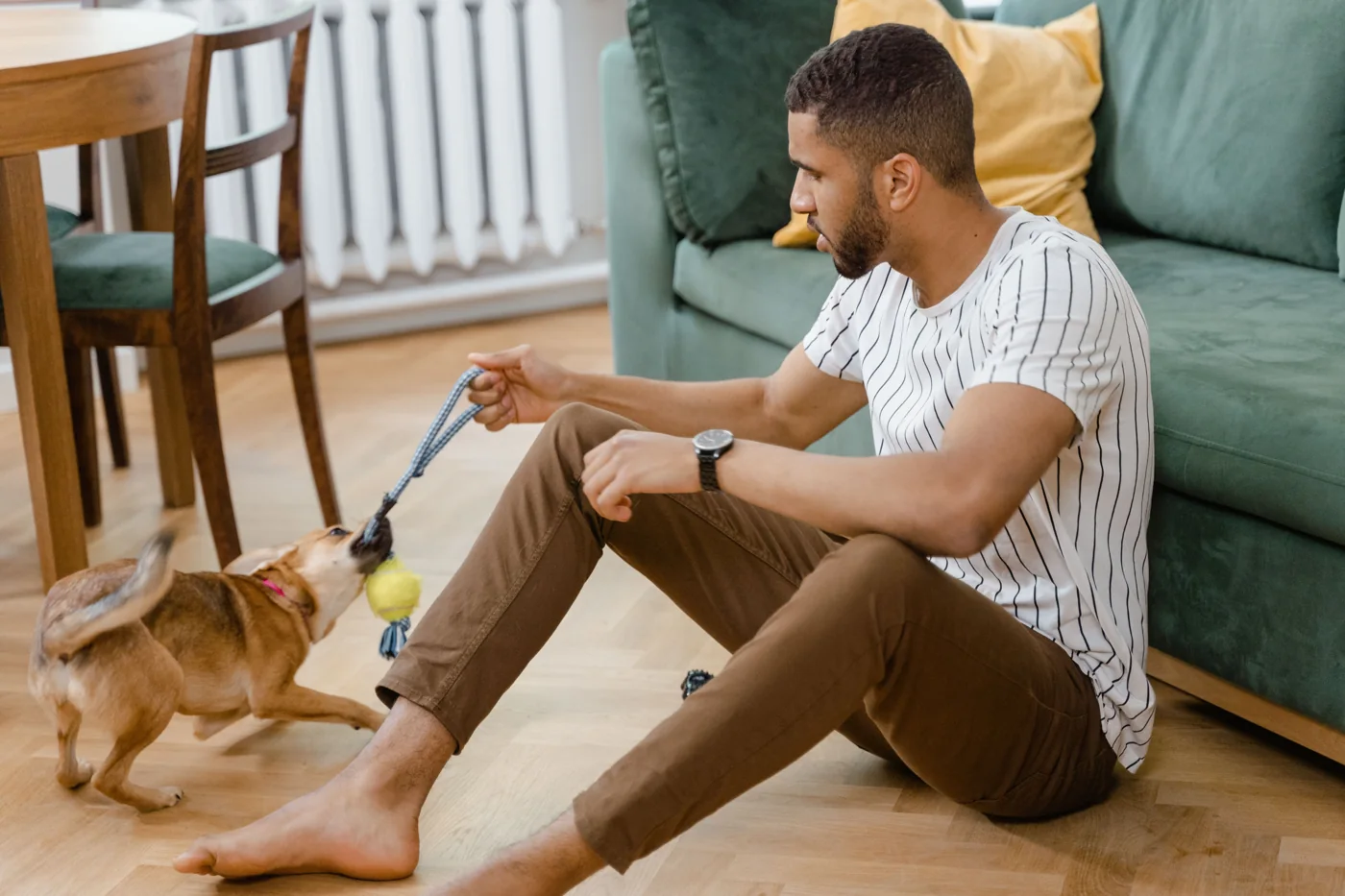
Choose an intact toy sized and designed for your dog’s interaction. Gentle play in a clear area can be easier to manage than throwing an object across the room. Keep movements appropriate to your dog’s health and avoid pulling them into awkward positions or lifting them by a toy.
If you use tug, keep it cooperative and controlled. Pause when the interaction becomes too intense or the space becomes unsuitable. Teach giving up the toy through reward-based practice in an easier context if that skill is missing. Do not put your hands into a guarding conflict to enforce the end of a game.
Inspect the toy during and after play
Loose seams, exposed stuffing, small detached parts, and damaged surfaces can change a toy’s suitability. Remove damaged items safely and choose another activity. If you think your dog swallowed something, contact your veterinarian for advice rather than waiting for the activity to prove harmful.
Plush toys are appropriate for some dogs and poor choices for others. Product claims such as “durable” cannot predict how your dog will use the item. Supervision means you are available to notice changes and respond. A new toy left with an unsupervised dog is a different use case.
A food toy is optional, not a requirement
You can use an already familiar, suitable food toy for a short activity. Prepare an easy version using food appropriate to your dog’s diet and the product. If you are introducing a new device, follow our puzzle-feeder introduction guide rather than assuming the rainy day requires an advanced challenge.
Skip improvised containers if your dog chews or swallows the material. A cardboard box or fabric roll is not a safe choice for every dog. Choose an alternative you can supervise comfortably, including a simple search without a container. Fewer materials can mean fewer ways for the activity to go wrong.

Build a day with breaks
| Part of the day | Possible choice |
|---|---|
| After essential morning care | An easy food search in a clear area. |
| During a manageable household break | A few repetitions of a familiar cue. |
| Later, when the dog is interested | Supervised play with an appropriate toy. |
| Between activities | Water, necessary care, and comfortable rest. |
This is a planning example, not a prescription for duration or frequency. Your dog may prefer two options, or need a different arrangement. Choose around actual care needs and available supervision. Do not wake a comfortably resting dog because the schedule says it is time for another game.
Plan what the caregiver can realistically do
If you are working from home, identify short periods when you can actively supervise. A meeting does not become supervision because the dog is beside your desk. Arrange help when necessary care exceeds your availability. Food toys may add variety, but they do not replace a caregiver during a difficult day.
Keep an easy fallback activity ready: a familiar cue game or a suitable toy already inspected. Store equipment where people can reach it and pets cannot. A rainy-day system is more useful when it requires little setup and can be repeated by another household member.
A worked example for a busy household
Imagine that two adults share dog care and both have morning meetings. One handles the necessary outing and breakfast; the other has a short break later. Instead of leaving several homemade puzzles on the floor, they choose one easy supervised search during that break. The food comes from a portion already set aside, so it is not added to the day by accident.
They put the search materials away afterward and allow ordinary downtime. Later, a familiar toy game fits another available period. If the first person’s meeting runs late, the fallback is an agreed caregiver handoff, not expecting the dog to wait because enrichment was provided earlier. This hypothetical example shows how the activities fit the people providing care.
Write the arrangement where both caregivers can see it. Include what has already happened, which food portion remains, and whether the dog needs the next bathroom opportunity. On the next rainy day, you can reuse a plan that worked rather than inventing entertainment while everyone is already busy.
Use the ending to judge the fit
Notice whether the dog can finish the activity comfortably and move on. Prolonged frustration, attempts to ingest materials, or conflict over an item indicate that the setup needs changing. Avoid assuming a dog has benefited because the activity occupied a long time.
Record one practical detail: which toy remained intact, which search area was easy to clean, or which cue was enjoyable in that setting. A brief note can improve the next wet day. The weekly enrichment menu offers a broader way to organize those observations.
Finish with cleanup and comfortable downtime
Remove leftover food and wash food-contact items according to their instructions. The FDA recommends washing pet-food bowls and utensils after use. Keep fresh water available and put damaged or unsuitable materials out of reach.
A good rainy-day plan preserves essential care, offers a few enjoyable choices, and leaves room for rest. Start with what your dog can do comfortably in your actual home. Thoughtful supervision and a simple setup matter more than filling the room with new equipment.
Sources & further reading
Sources checked October 13, 2026. AI-assisted editorial work by MyPupwise; professional review remains pending. No veterinary review is claimed. The day sequence and activity adaptations are original planning examples.
General guidance does not replace individual veterinary or behavior assessment.