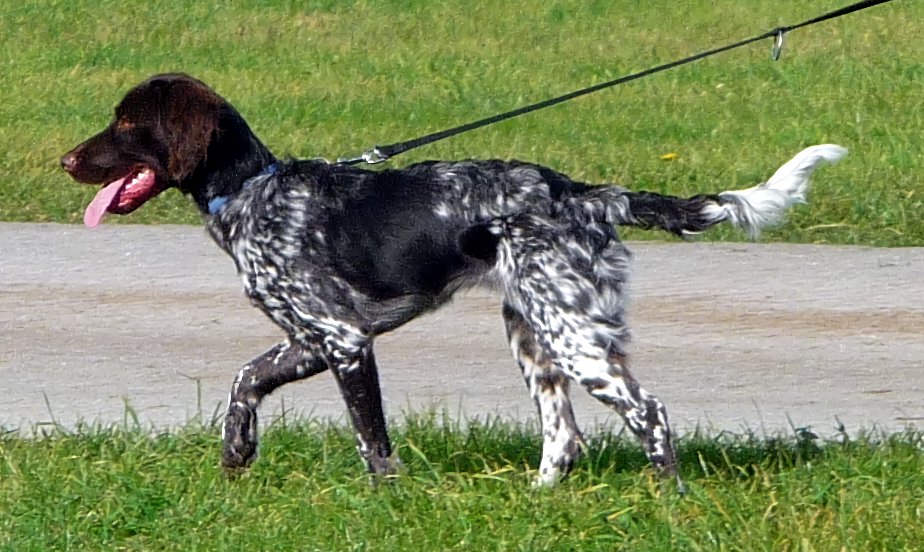
Ranges describe the registry profile, not a measurement, life expectancy, or health prediction for a particular dog. Separate sex or variety ranges are preserved where the source supplies them.
Source characteristics at a glance
The registry uses an ordinal 1–5 scale. A higher number indicates more of the named trait, not a better dog or a compatibility score. These descriptions are general and are not clinical measurements.
History and original work
The Small Munsterlander developed in Germany’s Munsterland region as a versatile pointing, retrieving, and tracking dog. Organized breeding brought together working lines in the early twentieth century. Its name distinguishes it from the Large Munsterlander rather than making it a small companion breed.
Training & behavior
Teach a rewarded wait, soft delivery, and returning attention during a short search. Expect an adolescent phase even after the body looks nearly adult, keeping boundaries and lessons manageable. Supervise children’s interactions and include comfortable household rest instead of leaving a versatile hunter to organize its own outdoor work.
Daily needs & enrichment
Combine searching, controlled land and water retrieves, and progressively conditioned hikes. Use secure boundaries around wildlife and check ears, toes, and feathering after cover. Develop coordination before strenuous repetitive work. Mental concentration and recovery belong beside movement rather than simply increasing distance.
Coat care
Brush the medium-length coat and comb through feathering at ears, legs, belly, and tail, checking for seeds after outings. Increase attention during seasonal shedding and use gentle root-level checks where equipment rubs. The natural working outline needs debris removal rather than elaborate sculpting.
Wash when dirty with dog shampoo, rinse thoroughly, and dry the inner hair and ear furnishings with towels and comfortable airflow. Limited foot and sanitary tidying can help daily care. Avoid cutting against hidden ear skin, leaving damp knots after swimming, or routine body shaving as a substitute for seasonal coat maintenance.
Living Environment & Daily Needs
Provide a Small Munsterlander purposeful movement and learning that engage its versatile hunting skills. Secure practice around wildlife and comfortable recovery should accompany daily involvement rather than expecting instinct or a yard to organize the routine.
Practical question
Is the Small Munsterlander simply a scaled-down Large Munsterlander?
They are distinct breeds with separate development. Choose this dog for its own working requirements, and do not interpret the name as a low-activity companion label.
Plan care for the individual dog
Budget, time alone and household compatibility depend on the individual dog and your circumstances. Use our care budget guide, time-alone planning guide and questions before adopting alongside the breed-specific source information above.
Health questions for a veterinarian
Hip and elbow assessment are documented breeding recommendations. Joint reports describe particular structural findings and do not exclude every cause of later stiffness or lameness. Request actual certificates and family health history rather than relying on hunting performance alone. Persistent limping, painful ears after water work, or unexplained loss of stamina needs investigation. Preventive vaccination and parasite plans should suit the individual and local exposure, rather than copying a fixed schedule from a breed description.
Editorial update: October 24, 2026. General information; individual care requires veterinary assessment. No veterinary review is claimed. See our Editorial Policy for sourcing and review practices.