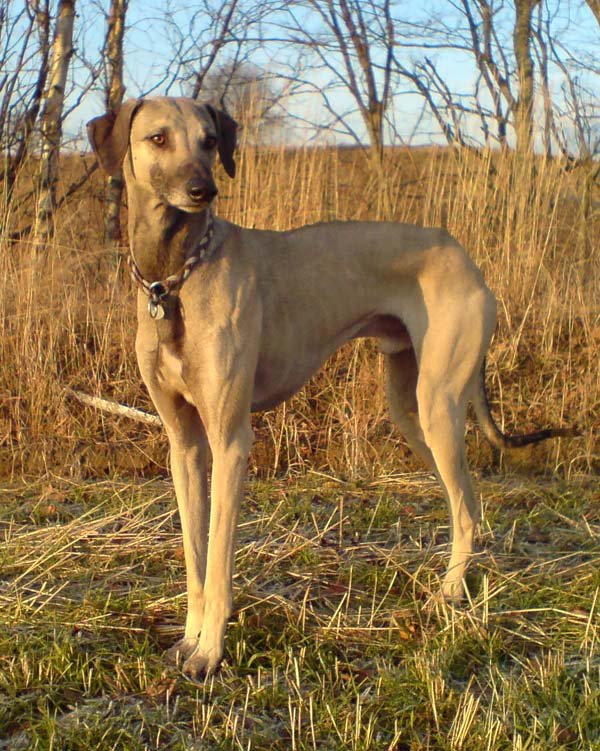
Ranges describe the registry profile, not a measurement, life expectancy, or health prediction for a particular dog. Separate sex or variety ranges are preserved where the source supplies them.
Source characteristics at a glance
The registry uses an ordinal 1–5 scale. A higher number indicates more of the named trait, not a better dog or a compatibility score. These descriptions are general and are not clinical measurements.
History and original work
The Sloughi developed as a hunting sighthound in North Africa. Morocco holds the FCI standard, while the breed's wider history includes neighboring North African countries. 'Arabian Greyhound' is an alternative name, not a country of origin. Accounts of its earliest ancestry remain uncertain.
Temperament and training
Let a reserved Sloughi approach visitors rather than asking strangers to crowd or restrain it. Reward voluntary attention and practice recall behind secure fencing before adding movement distractions. A history of coursing makes cats and small animals a management question, even when the dog is gentle with familiar people. Children should respect retreat and resting space.
Daily needs & enrichment
Combine exploratory leash walks with opportunities to gallop in a suitable enclosed area. Check gates and fencing before releasing the dog; a promising recall does not remove the pull of fast-moving wildlife. An introductory lure-coursing session with knowledgeable supervision may provide an outlet. Allow recovery rather than repeating sprints until exhausted.
Coat care
Brush the short fine coat weekly with a soft bristle brush or hound mitt. Inspect feet and skin after running, and maintain nails through short rewarded sessions. There is no long undercoat to rake aggressively.
Bathe occasionally for dirt with dog shampoo, rinse fully, and towel dry without chilling the dog. Avoid harsh scraping, hot drying, and unnecessary clipping. Adapt outings and rest to a lean short-coated individual’s comfort rather than using a universal temperature cutoff.
Living Environment & Daily Needs
Give a Sloughi unpressured introductions and secure opportunities to use its running ability. Quiet closeness and comfortable rest should accompany realistic management of pursuit, rather than assuming a reserved manner means little activity is needed.
Care through life stages
Puppies need gentle handling, confident footing, and secure exploration. Condition adults progressively for running and allow recovery rather than repeated exhausting sprints. For seniors, adapt traction, access, and distances; investigate new lameness or difficulty seeing in dim light.
Frequently asked questions
Is good recall enough for off-leash exercise? It cannot guarantee a Sloughi will ignore fast-moving wildlife. Use a suitable secure enclosure and check gates and fencing before allowing running.
Questions to ask before choosing a dog
Can you provide eye reports and PRA-rcd1a results linked to the parents' identities? How does this Sloughi behave when a cat runs or a visitor reaches toward it? Ask to see its normal recovery after exercise and find out which enclosed running arrangements it has used safely.
Plan care for the individual dog
Budget, time alone and household compatibility depend on the individual dog and your circumstances. Use our care budget guide, time-alone planning guide and questions before adopting alongside the breed-specific source information above.
Health questions for a veterinarian
Progressive retinal atrophy can cause inherited loss of vision in Sloughis. Ask for parental eye-examination reports and the result for the Sloughi-specific PRA-rcd1a DNA test. The genetic result and the eye examination answer different questions: neither excludes every cause of impaired sight. Hesitation in dim light or a new difficulty navigating deserves veterinary assessment. Discuss family illness and the dog's conditioning before demanding running work; an athletic appearance is not a health clearance.
Updated October 25, 2026. General information; see our Editorial Policy for sourcing and review practices.