Ranges describe the registry profile, not a measurement, life expectancy, or health prediction for a particular dog. Separate sex or variety ranges are preserved where the source supplies them.
Source characteristics at a glance
The registry uses an ordinal 1–5 scale. A higher number indicates more of the named trait, not a better dog or a compatibility score. These descriptions are general and are not clinical measurements.
History and original work
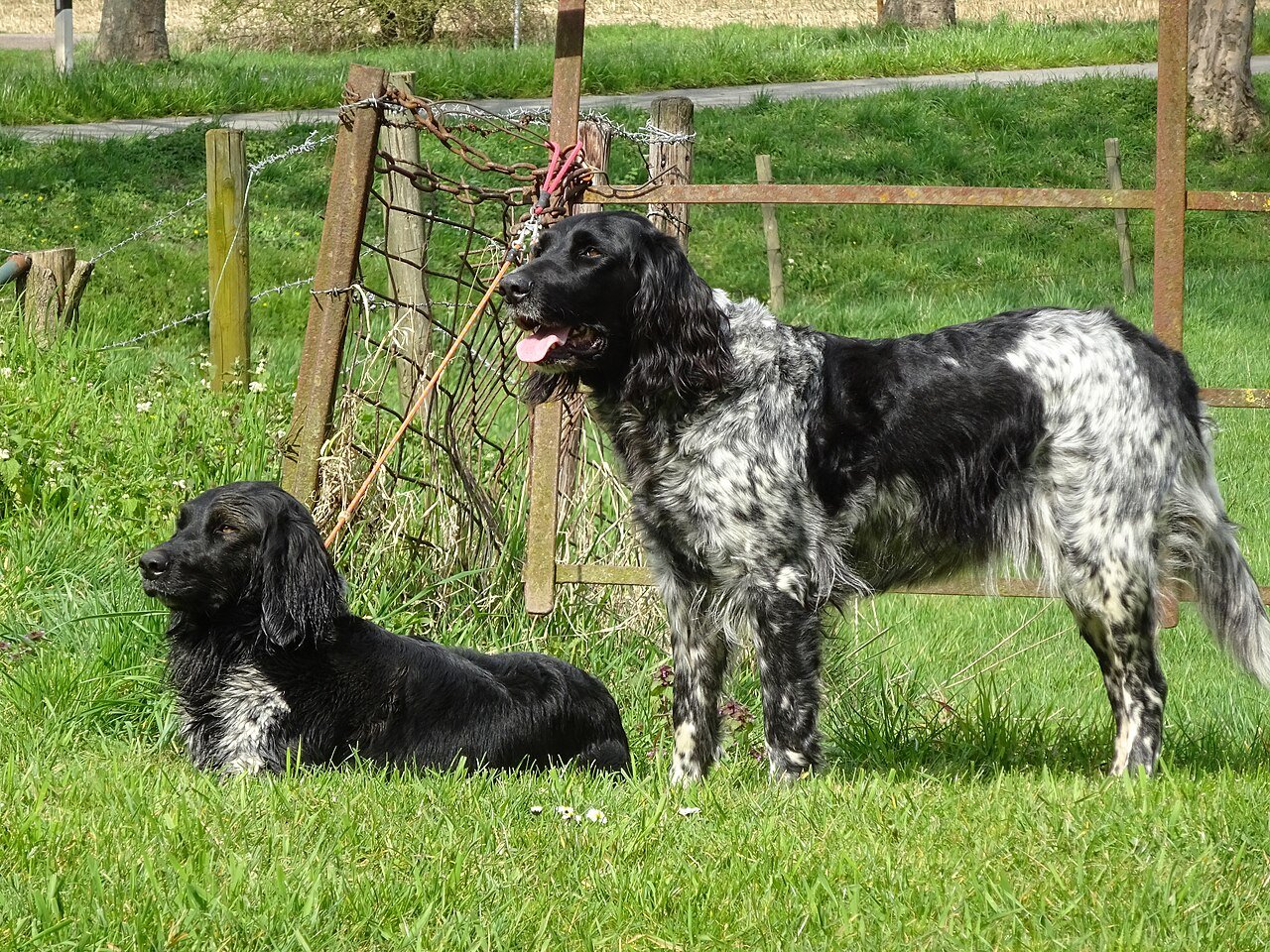
The Large Munsterlander developed in Germany from black-and-white longhaired pointing dogs, with its own organized breeding after separation from German Longhaired Pointer lines. It was selected for versatile work in fields, woodland, and water. Its feathered coat therefore needs practical checks after demanding outings.
Training & behavior
Build a steady wait, a gentle delivery, and a recall within secure boundaries before adding game distractions. Reward turning toward you with another controlled search. Prevent self-directed hunting through line and gate management. Quick learning does not remove the need for daily participation with a handler.
Daily needs & enrichment
Offer progressively conditioned tracking, dummy searches, retrieves, and hikes. Introduce water safely with an accessible exit and rest before fatigue. Puppies need manageable terrain and delivery foundations before repeated leaps or distance work. Varied purposeful tasks matter more than access to land without supervision.
Coat care
Brush and comb the long coat, concentrating on ear bases, chest, belly, backs of legs, and tail. Remove burrs after cover work before they tighten into mats, and increase loose-hair removal during shedding. Support feathering at its roots while easing tangles from the ends.
Bathe after significant soiling with dog shampoo, rinse completely, and dry ear bases and feathering to the roots using towels and gentle airflow. Limited foot or sanitary tidying can help; a close body clip is not routine care. Avoid blind cutting beneath a knot or vigorous rubbing of a muddy tail abrasion.
Living Environment & Daily Needs
Plan substantial activity and retrieving-related work for a Large Munsterlander. Make safe outings, full-sized rest, and feathering checks practical, with daily involvement that reflects a versatile hunting background.
Practical question
Can a large property provide the required activity by itself?
No. Without supervised work a driven dog may choose its own hunt; plan regular searching, conditioning, and recovery with a caregiver.
Plan care for the individual dog
Budget, time alone and household compatibility depend on the individual dog and your circumstances. Use our care budget guide, time-alone planning guide and questions before adopting alongside the breed-specific source information above.
Health questions for a veterinarian
Reliable breed-wide frequencies are limited, so request documented breeding health records and family history instead of relying on a general assertion of robustness. Discuss relevant joint and eye evaluation in the context of the individual’s work and lineage; an unspecified DNA panel is not proof that all inherited disease was assessed. Persistent lameness, eye discomfort, or a decline in working stamina needs examination. Check for injuries and recurring ear inflammation after cover and water work.
Editorial update: October 24, 2026. General information; individual care requires veterinary assessment. No veterinary review is claimed. See our Editorial Policy for sourcing and review practices.