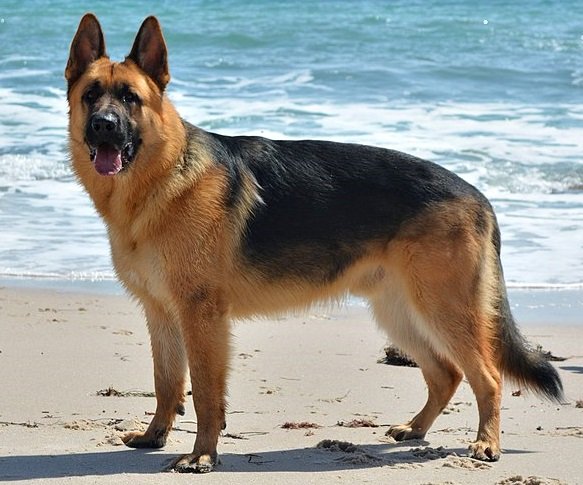
Ranges describe the registry profile, not a measurement, life expectancy, or health prediction for a particular dog. Separate sex or variety ranges are preserved where the source supplies them.
Source characteristics at a glance
The registry uses an ordinal 1–5 scale. A higher number indicates more of the named trait, not a better dog or a compatibility score. These descriptions are general and are not clinical measurements.
History and original work
The modern German Shepherd Dog took shape in late nineteenth-century Germany under Max von Stephanitz, drawing on regional herding dogs. Selection for useful working ability supported later roles in service, search, and protection. That history makes thoughtful tasks and physical soundness relevant to everyday care.
Training & behavior
Reward calm observation of people and dogs at a comfortable distance instead of demanding greetings. Teach going to a mat when visitors arrive, a reliable trade, and loose-leash turns. Use scent tasks and short obedience sequences, then practice resting. Do not encourage rehearsed fence charging as an outlet for protective behavior.
Daily needs & enrichment
Tracking, searching for a hidden article, rally, and conditioned hikes combine movement with a task. Young dogs need body-awareness exercises and good footing before repetitive impact work. Adjust difficulty for orthopedic comfort. Constant ball chasing can increase arousal without teaching the ability to stop and recover.
Coat care
Brush the double coat every few days, increasing gentle work during heavy undercoat shedding. Use a slicker or pin brush followed by a comb through the neck, trousers, and behind the ears; long-coated dogs need extra checks in feathered areas. Remove loose wool without dragging tools repeatedly over skin.
Bathe when needed, rinse dog shampoo down to the roots, and dry the undercoat completely with towels and cool airflow. Routine shaving is not the answer to seasonal shedding. Keep foot hair practical if necessary, and investigate localized hair loss, sores, or odor rather than treating them as ordinary molting.
Living Environment & Daily Needs
A German Shepherd's home plan needs purposeful learning, varied mental work, and physical activity. Include patient introductions, comfortable recovery time, and shedding cleanup rather than relying on working intelligence or available land to supply good manners.
Practical question
Does a DNA result explain new hind-leg weakness?
Not by itself. A clinical examination is needed to distinguish joint, spinal, and neurological problems rather than assuming degenerative myelopathy from a risk result.
Plan care for the individual dog
Budget, time alone and household compatibility depend on the individual dog and your circumstances. Use our care budget guide, time-alone planning guide and questions before adopting alongside the breed-specific source information above.
Health questions for a veterinarian
Hip and elbow radiographs evaluate joint development. A degenerative myelopathy DNA test identifies a risk variant; it neither diagnoses the cause of weakness nor means every at-risk dog will develop the disease. Progressive hind-limb difficulty needs examination because other causes may be treatable. Repeated unproductive retching, a swollen abdomen, or collapse can indicate gastric dilatation-volvulus and requires emergency care immediately. Normal breeding screens do not exclude that emergency.
Editorial update: October 24, 2026. General information; individual care requires veterinary assessment. No veterinary review is claimed. See our Editorial Policy for sourcing and review practices.