Ranges describe the registry profile, not a measurement, life expectancy, or health prediction for a particular dog. Separate sex or variety ranges are preserved where the source supplies them.
Source characteristics at a glance
The registry uses an ordinal 1–5 scale. A higher number indicates more of the named trait, not a better dog or a compatibility score. These descriptions are general and are not clinical measurements.
History and original work
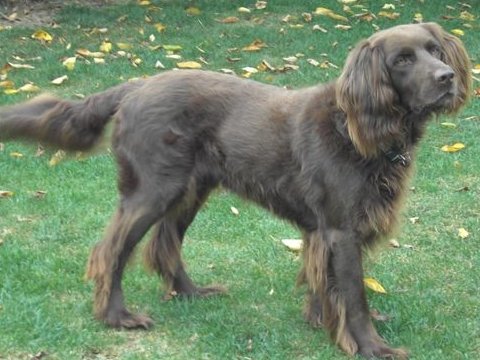
The German Longhaired Pointer developed in Germany as a versatile hunting dog for searching, pointing, and retrieving on land and in water. Organized breeding took shape in the nineteenth century. The flowing coat is a working covering, with feathering that needs attention after dense vegetation.
Training & behavior
Use the chance to resume searching as a reward for turning toward you. Rehearse stop, recall, and delivery in an enclosed area before adding wildlife distractions. Trade found objects for a reward instead of chasing the dog. Plan regular joint work; intelligence alone will not occupy a driven bird dog.
Daily needs & enrichment
Offer substantial, progressively conditioned field-style searches, tracking, and retrieving. Swimming needs safe access and breaks rather than an assumption that enthusiasm prevents fatigue. Puppies and unfit adults need easier terrain and shorter tasks. An occasional long outing cannot replace dependable opportunities to work with a handler.
Coat care
Use a pin brush and metal comb through the feathering, especially at the bases of the ears, beneath the chest, and around the legs. Check after every outing in cover for burrs, ticks, and abrasions on the tail. Gently separate debris before it tangles more tightly; do not tug at ear skin.
Bathe after significant soiling, rinse dog shampoo completely, and dry the ear bases and feathering to the roots with towels and cool airflow. Targeted foot or sanitary tidying can help; routine close body shaving is unnecessary. Have tightly embedded burrs or mats removed safely rather than cutting blindly against hidden skin.
Living Environment & Daily Needs
Plan substantial daily activity and searching tasks for a German Longhaired Pointer, with safe arrangements for outings. Make rest and feathering checks practical after outdoor time, rather than treating a flowing coat as only an appearance feature.
Practical question
Will weekend hunting make up for an inactive week?
Usually the plan needs more regular engagement. Build purposeful searching and physical conditioning into ordinary days, with recovery rather than sudden strenuous catch-up outings.
Plan care for the individual dog
Budget, time alone and household compatibility depend on the individual dog and your circumstances. Use our care budget guide, time-alone planning guide and questions before adopting alongside the breed-specific source information above.
Health questions for a veterinarian
Reliable breed-wide health frequencies are limited, and a reputation for robustness is not a health clearance. Request documented family history and discuss orthopedic evaluation appropriate to a large active dog rather than accepting an unspecified claim of genetic testing. Persistent limping or reduced willingness to work needs examination. After cover or water activity, inspect feet and ears; recurrent shaking, discharge, or a painful ear requires assessment rather than repeated home cleaning.
Editorial update: October 24, 2026. General information; individual care requires veterinary assessment. No veterinary review is claimed. See our Editorial Policy for sourcing and review practices.