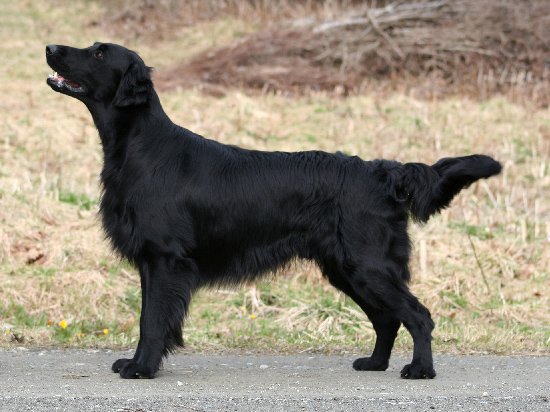
Ranges describe the registry profile, not a measurement, life expectancy, or health prediction for a particular dog. Separate sex or variety ranges are preserved where the source supplies them.
Source characteristics at a glance
The registry uses an ordinal 1–5 scale. A higher number indicates more of the named trait, not a better dog or a compatibility score. These descriptions are general and are not clinical measurements.
History and original work
The Flat-Coated Retriever developed in Britain as a versatile gundog for finding and retrieving game on land and water. Its flat-lying coat distinguishes it from curly-coated retrievers. The breed often retains a youthful enthusiasm into adulthood, but that tendency is not a substitute for assessing individual behavior, conditioning, and health.
Training & behavior
Reward a steady wait before a retrieve and a gentle delivery, then end or restart the game deliberately. Practice greeting without jumping and carrying appropriate toys instead of clothing or household objects. Use food and play with patient repetition rather than harsh corrections. Do not wait for age alone to create manners in an exuberant adult.
Daily needs & enrichment
Mix retrieving, tracking, exploratory walks, and safely introduced swimming. Use clear pauses and varied tasks instead of throwing until the dog is exhausted. Condition gradually for demanding work and check paws and feathering afterward. Growing dogs need appropriate foundations and good footing before repetitive jumps or long forced runs.
Coat care
Use a brush and metal comb weekly on the moderate-length coat, checking ear fringes, chest, belly, legs, and tail. Remove burrs and loose hair without lifting or trimming the coat into an artificial fluffy outline. Inspect friction areas after harness use and water work.
Bathe when dirty, rinse dog shampoo completely, and towel-blot before drying the furnishings and roots with gentle airflow. Modest foot, ear-edge, or sanitary tidying may help; routine close body clipping is unnecessary. Avoid hot drying or scissors against hidden skin, and investigate persistent ear odor rather than treating it with more scented baths.
Living Environment & Daily Needs
Plan active shared days and consistent manners practice for a Flat-Coated Retriever. Its youthful enthusiasm needs a dependable outlet and comfortable downtime; waiting for age or providing a yard alone does not organize the routine.
Practical question
Can a young-at-heart personality rule out pain or illness?
No. A retriever may remain eager to participate despite discomfort; changes in recovery, appetite, gait, or body condition deserve attention.
Plan care for the individual dog
Budget, time alone and household compatibility depend on the individual dog and your circumstances. Use our care budget guide, time-alone planning guide and questions before adopting alongside the breed-specific source information above.
Health questions for a veterinarian
Hip and patellar evaluations and regular ophthalmologist examinations are documented screening priorities. Cancer is a significant concern in the breed, including several different tumor types; normal breeding screens do not exclude it, and there is no single routine clearance for all cancers. Ask about illness and longevity in relatives without treating a small family sample as population prevalence. New or changing lumps, unexplained weight loss, persistent lameness, reduced stamina, or sudden collapse needs veterinary attention rather than being attributed to aging alone.
Editorial update: October 24, 2026. General information; individual care requires veterinary assessment. No veterinary review is claimed. See our Editorial Policy for sourcing and review practices.