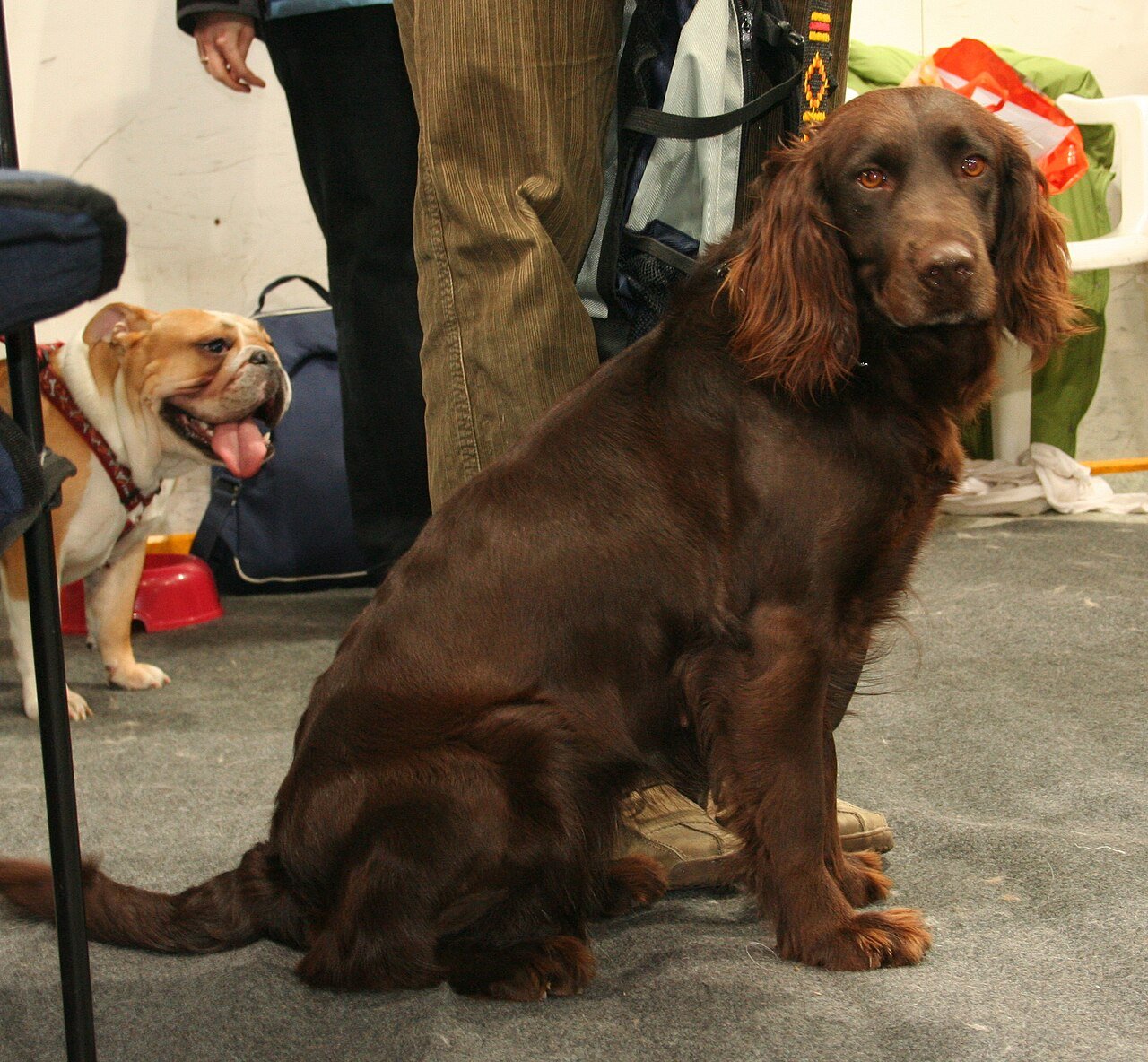
Ranges describe the registry profile, not a measurement, life expectancy, or health prediction for a particular dog. Separate sex or variety ranges are preserved where the source supplies them.
Source characteristics at a glance
The registry uses an ordinal 1–5 scale. A higher number indicates more of the named trait, not a better dog or a compatibility score. These descriptions are general and are not clinical measurements.
History and original work
The Deutscher Wachtelhund, or German Spaniel, was established by German hunters from regional flushing dogs around the turn of the twentieth century. Searching cover, following a trail with voice, and retrieving were valued working abilities. It remains strongly associated with hunting, so ordinary companionship plans need to account for that purpose.
Training & behavior
Practice returning from a scent on a line, waiting before entering cover, and delivering a dummy without a struggle. Reward contact with the handler during searching rather than trying to eliminate exploration. Keep wildlife work within lawful, supervised training settings. A dog selected to follow game independently needs secure boundaries and rehearsed cues before difficult distractions.
Daily needs & enrichment
Provide structured tracking, cover searches, retrieving, and gradually conditioned hikes. A plain walk may not fully occupy a dog bred for sustained scent work, so add a task with a clear beginning and end. Inspect the terrain and paws and allow recovery. Puppies should learn foundations before forced running or demanding work over rough ground.
Coat care
Brush and comb the thick, wavy or curly body coat weekly, giving extra attention to the ear fringes, belly, legs, and tail. Remove burrs after working through cover rather than letting them tighten into knots. The fine hair of the head needs lighter handling than dense furnishings.
Bathe when muddy or dirty, rinse dog shampoo through the coat, and dry roots and feathering with towels and cool airflow. Limited tidying between toes may help when hair traps debris; routine body clipping is not necessary. Avoid leaving damp ear hair against skin, cutting into hidden mats, or pouring cleanser into painful ears without an examination.
Living Environment & Daily Needs
A Wachtelhund's hunting purpose needs meaningful outlets for tracking and other shared work. Consider its trail voice and secure activity arrangements, and evaluate the caregiver's routine rather than assuming ordinary walks or outdoor space will suffice.
Practical question
Does hunting interest mean unsupervised time in a large yard is enough?
No. It provides neither a guided task nor reliable control of scent pursuit. Plan shared work and a secure place to recover afterward.
Plan care for the individual dog
Budget, time alone and household compatibility depend on the individual dog and your circumstances. Use our care budget guide, time-alone planning guide and questions before adopting alongside the breed-specific source information above.
Health questions for a veterinarian
Hip and elbow evaluation and eye assessment feature in health programs for the breed. Joint imaging provides information beyond apparent working soundness. Ear inflammation and skin allergies also deserve attention: persistent head shaking, odor, itching, or recurrent paw irritation needs investigation rather than repeated cleaning alone. After field work, a grass awn may be hidden in an ear or between toes. Specific screening results cannot rule out those injuries or every inherited condition, and working enthusiasm does not prove absence of pain.
Editorial update: October 24, 2026. General information; individual care requires veterinary assessment. No veterinary review is claimed. See our Editorial Policy for sourcing and review practices.