Ranges describe the registry profile, not a measurement, life expectancy, or health prediction for a particular dog. Separate sex or variety ranges are preserved where the source supplies them.
Source characteristics at a glance
The registry uses an ordinal 1–5 scale. A higher number indicates more of the named trait, not a better dog or a compatibility score. These descriptions are general and are not clinical measurements.
History and original work
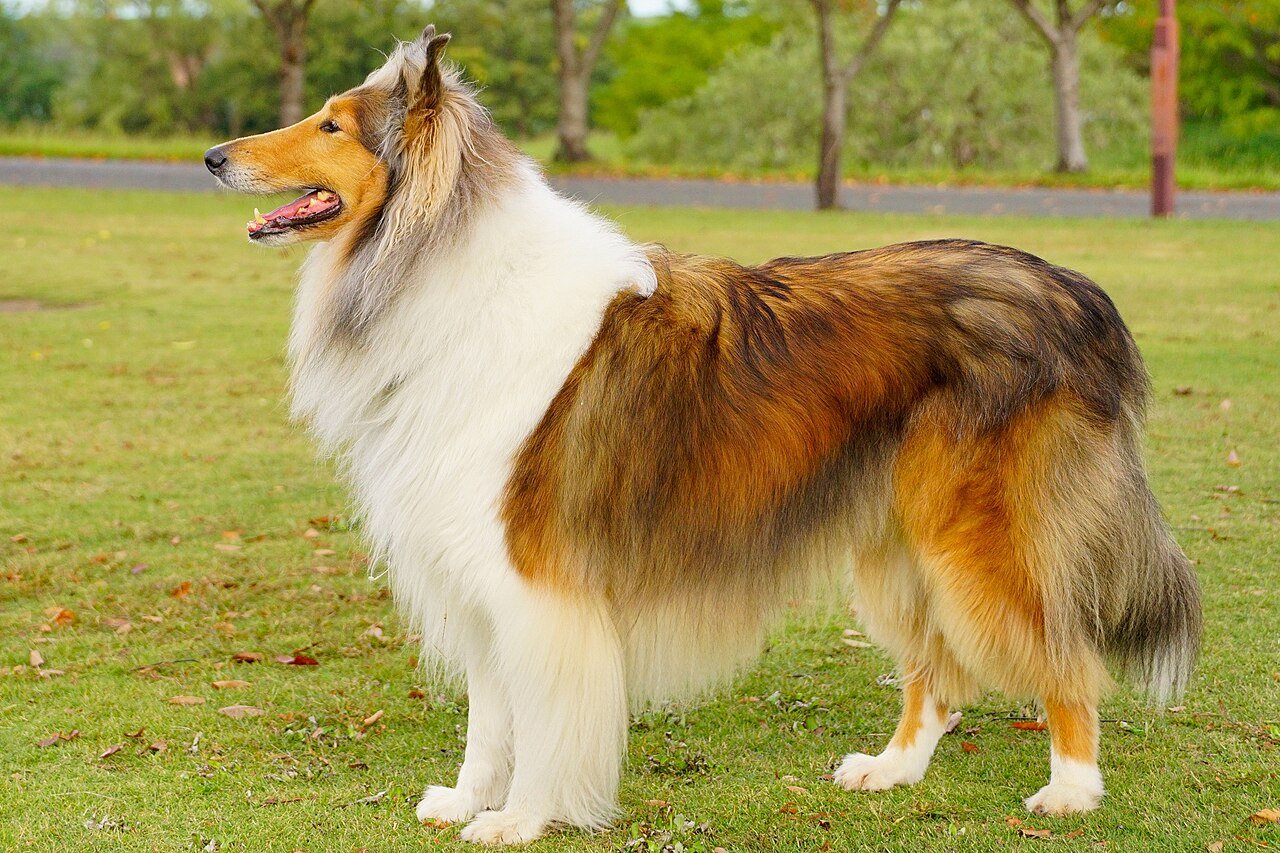
Collies worked livestock in Scotland and northern England before becoming widely known as companions and show dogs. Their exact early development is not fully documented. Rough and Smooth are coat varieties, not evidence of different needs for a relationship with people. Both retain a herding dog's awareness of movement and readiness to use its voice.
Training & behavior
Reward disengagement from running children or bicycles before barking and chasing escalate. Practice a quiet mat station with ordinary household movement at a manageable distance. Use soft, clear cues and brief successes rather than drilling or shouting. Teach comfortable brushing and examination of the mouth and feet with rewards, especially when handling a sensitive youngster.
Daily needs & enrichment
Combine exploratory walks, controlled retrieving, and rally or herding foundations with rest. A fenced area allows movement without rehearsing pursuit toward traffic. Build jumping and endurance gradually as physical development permits. If barking continues after outings, examine triggers and settling skills rather than automatically adding more frantic exercise.
Coat care
For a Rough Collie, part the long coat weekly and brush through to the skin, then comb behind the ears, under the elbows, and in the hindquarter feathering. Smooth Collies also have undercoat: use an appropriate brush to remove loose hair even though the outer coat is short. Increase attention during heavy shedding in either variety.
Bathe when dirty, rinse dog shampoo completely, and dry the roots rather than only the surface. Towels and cool moving air help with dense areas. Routine body shaving is unnecessary; careful foot or sanitary tidying is different. Avoid pulling compacted undercoat or cutting mats against skin hidden by the coat.
Living Environment & Daily Needs
Plan gentle learning, activity, and company for a responsive Collie, with chances to settle around household sounds. Coat arrangements should reflect the Rough or Smooth variety, and the individual's voice deserves attention in any neighborhood.
Practical question
Does the Smooth variety avoid seasonal shedding?
No. Its shorter outer hair still covers undercoat, which can be shed heavily and requires brushing.
Plan care for the individual dog
Budget, time alone and household compatibility depend on the individual dog and your circumstances. Use our care budget guide, time-alone planning guide and questions before adopting alongside the breed-specific source information above.
Health questions for a veterinarian
Collie eye anomaly requires attention early in puppyhood; an ophthalmologist's examination and a specific DNA test provide different information. DNA results do not exclude every eye disorder. MDR1/ABCB1 testing can identify drug sensitivity, so keep the result in the medical record and tell each prescribing veterinarian. Do not alter treatment doses or use livestock antiparasitic preparations yourself. New visual difficulty, a seizure, or progressive weakness needs assessment even when parental screening results were normal.
The club also highlights PRA-rcd2 testing for a separate inherited retinal disease and DMS testing to inform dermatomyositis risk. Dermatomyositis affects skin and sometimes muscle; its genetic risk assessment is not a diagnosis or a guarantee that disease will develop. Ask which results are available rather than treating an eye-anomaly test as a complete genetic clearance.
Editorial update: October 26, 2026. General information; individual care requires veterinary assessment. No veterinary review is claimed. See our Editorial Policy for sourcing and review practices.