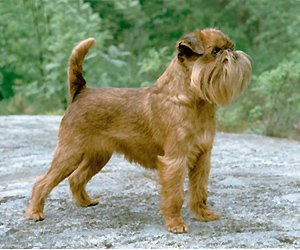
Ranges describe the registry profile, not a measurement, life expectancy, or health prediction for a particular dog. Separate sex or variety ranges are preserved where the source supplies them.
Source characteristics at a glance
The registry uses an ordinal 1–5 scale. A higher number indicates more of the named trait, not a better dog or a compatibility score. These descriptions are general and are not clinical measurements.
History and original work
The Brussels Griffon developed in Belgium from small stable-associated dogs that became valued companions. Later toy-dog influences contributed to the modern short face and rough or smooth coats, although exact early crosses were not fully recorded. The two coat types need different maintenance.
Temperament and training
A Brussels Griffon often develops a close attachment and notices small changes in household activity. Patient rewards support cooperation with this sensitive companion. Practice brief independence and toilet routines consistently; harsh corrections can undermine comfort and learning.
Daily needs & enrichment
Offer walks, gentle play, and short lessons with rest between activities. This companion needs involvement without being treated as an endurance runner. Watch breathing and comfort, especially during warm or humid weather.
Coat care
For the smooth coat, weekly soft brushing removes loose hair, with daily gentle brushing during heavy shedding. For the rough coat, brush and comb beard, ear bases, armpits, and legs, maintaining the jacket through skilled stripping or a practical pet clip. Clipped rough hair still needs root-level checks.
Bathe for genuine dirt with dog shampoo, rinse fully, and dry facial hair and coat roots gently. Keep food residue from the beard and hair away from the eyes. Avoid hot airflow around the short face, forceful plucking of attached coat, scissors beneath mats, and assuming the smooth variety needs a rough jacket’s stripping routine.
Living Environment & Daily Needs
Arrange predictable company and a resting space away from rough activity. Practice comfortable separation in small steps and establish dependable toilet access. The expressive short face also makes breathing comfort and temperature management practical everyday concerns.
Care costs and grooming budget
Compare grooming costs for rough and smooth coats separately. Include dental care, preventive visits, and possible evaluation of breathing or eye concerns; a small food allowance does not cover those commitments.
Independence and backup care
Find out how this Griffon manages short separations and care from another familiar person. Strong attachment does not automatically mean a behavioral disorder, but a sudden long absence may be difficult. Arrange support around observed comfort and toilet needs.
Safe family and animal introductions
A home with chasing, grabbing, or unpredictable handling can be a difficult match for this sensitive small dog. Adults should supervise gentle contact, protect rest, and introduce other animals gradually with room for the Griffon to leave.
Comfort in different weather
Short facial structure can affect breathing and heat tolerance. Keep activity comfortable, avoid strenuous outings in heat, and discuss individual limitations with your veterinarian. Do not dismiss persistent breathing noise as an amusing breed feature.
Preparing for your first dog of this breed
A patient beginner needs time for company, toilet training, and gradual handling lessons. Learn the coat variety's care and discuss facial conformation with a veterinarian before assuming that a small companion has simple needs.
Care through life stages
Puppies need safe handling and a gentle introduction to grooming and brief independence. Reassess activity and breathing comfort through adulthood. For older Griffons, adapt rest and access around any dental, eye, or mobility issues identified by a veterinarian.
Questions to ask before choosing a dog
How does this Griffon cope with separations, grooming, visitors, and children's movement? Ask for patella, hip, and eye screening information, breathing history, and any additional investigations recommended by the breed club for its family line.
Practical question
Does a smooth-coated Griffon need the rough variety’s stripping routine?
No. Maintain the smooth covering with appropriate brushing and occasional bathing. Rough coats need a separate jacket and beard plan, with comb checks even when clipped.
Health and screening questions
Patellar, hip, and ophthalmologist examinations are documented core recommendations. They answer different questions and do not assess every short-faced airway or neurological concern. Ask about actual results and relevant family history. Persistent breathing noise, poor heat recovery, neck pain, or repeated abnormal scratching deserves investigation; breathing distress is urgent. A suddenly painful eye also needs prompt care. Normal screening and a distinctive facial appearance are not substitutes for an individual clinical assessment.
Editorial update: October 26, 2026. General information; individual care requires veterinary assessment. No veterinary review is claimed. See our Editorial Policy for sourcing and review practices.