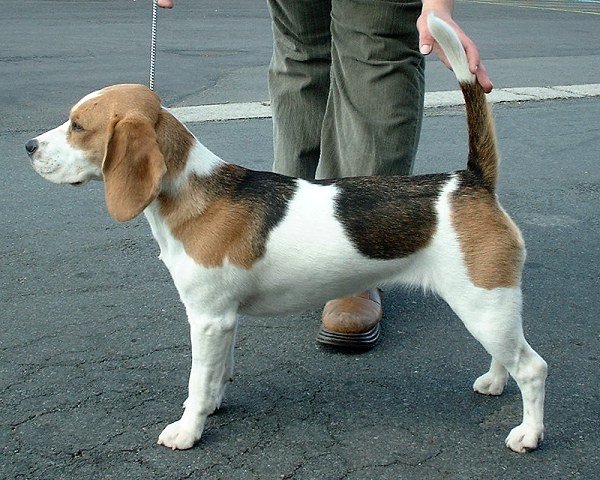
Ranges describe the registry profile, not a measurement, life expectancy, or health prediction for a particular dog. Separate sex or variety ranges are preserved where the source supplies them.
Source characteristics at a glance
The registry uses an ordinal 1–5 scale. A higher number indicates more of the named trait, not a better dog or a compatibility score. These descriptions are general and are not clinical measurements.
History and original work
The Beagle's modern history is rooted in British small pack hounds used to hunt hare and rabbit with people following on foot. Its exact earliest origins and the derivation of its name remain uncertain. Later American development retained the compact working hound's nose, voice, and enthusiasm for following a trail.
Temperament and training
Reward attention before a scent becomes overwhelming, and use permission to resume sniffing as part of training. Food can be valuable, but teach waiting and leave-it around kitchen counters and dropped items. Practice comfortable time apart without assuming that pack ancestry means another dog will solve distress. Supervise children around food and resting spaces as with any individual dog.
Daily needs & enrichment
Scatter a small part of the day's food in a safe search area, lay an easy trail, or vary an exploratory walking route. These activities let the dog use its nose without running loose after wildlife. Check gates and digging opportunities; successful recall indoors is not a secure outdoor plan. Include companionship and recovery rather than leaving the dog to exercise itself around a perimeter.
Coat care
A dense double coat sits beneath the smooth outline and releases loose hair year-round, with more during coat changes. A mitt or appropriate brush helps remove it. Check long ears and between the toes after outdoor searches, and introduce nail handling comfortably. A coat that dries quickly does not mean painful ears or recurring skin irritation can be left to resolve without assessment.
Brush weekly with a medium-bristle brush, rubber mitt, or hound glove, increasing gentle sessions during coat changes. Bathe for substantial dirt, rinse fully, and dry comfortably. Avoid harsh scraping and unnecessary shaving; include regular ear and foot checks.
Living Environment & Daily Needs
Build secure sniffing opportunities and patient training into a Beagle's day. Its pack-hunting background makes shared activity relevant, while its noticeable voice deserves a plan for household sounds and nearby neighbors in any setting.
Care through life stages
Puppies need secure exploration and food-reward lessons that count toward the daily food allowance. Adults need shared scent work and body-condition monitoring. Seniors may need easier access and adapted searches; visual changes, unusual bleeding, or seizures need veterinary assessment.
Frequently asked questions
Should training treats be added on top of the normal food allowance? Count them within the feeding plan. Match portions to the individual’s body condition and activity with veterinary guidance instead of accepting excess weight as an ordinary Beagle feature.
Questions to ask before choosing a dog
Can the caregiver describe this individual's voice, food-seeking, response to a scent, and comfort when company leaves? Ask for MLS and other relevant laboratory reports and the parents' clinical evaluations. Plan secure, enjoyable nose work and a feeding routine that includes training rewards. Meet an adult Beagle in ordinary household life as well as in an appealing photograph.
Plan care for the individual dog
Budget, time alone and household compatibility depend on the individual dog and your circumstances. Use our care budget guide, time-alone planning guide and questions before adopting alongside the breed-specific source information above.
Health questions for a veterinarian
Musladin-Lueke syndrome is an inherited connective-tissue disorder in Beagles; a DNA test addresses that condition, not every cause of stiffness or an unusual gait. Ask for the actual MLS report alongside hip, cardiac, eye, and thyroid information recommended by the breed club or registry. Other breed-relevant genetic tests exist, including for Factor VII deficiency and several eye or metabolic conditions, so the named variant and family history matter more than the number of tests on a panel. A clear panel does not exclude epilepsy, joint disease, or all visual problems. Persistent limping, changes in vision, unusual bleeding, or seizures need veterinary assessment. Match food portions to body condition, including treats used in training, rather than accepting excess weight as typical Beagle shape.
Updated October 25, 2026. General information; see our Editorial Policy for sourcing and review practices.