Displayed with responsive cropping.
Ranges describe the registry profile, not a measurement, life expectancy, or health prediction for a particular dog. Separate sex or variety ranges are preserved where the source supplies them.
Source characteristics at a glance
The registry uses an ordinal 1–5 scale. A higher number indicates more of the named trait, not a better dog or a compatibility score. These descriptions are general and are not clinical measurements.
History and original work
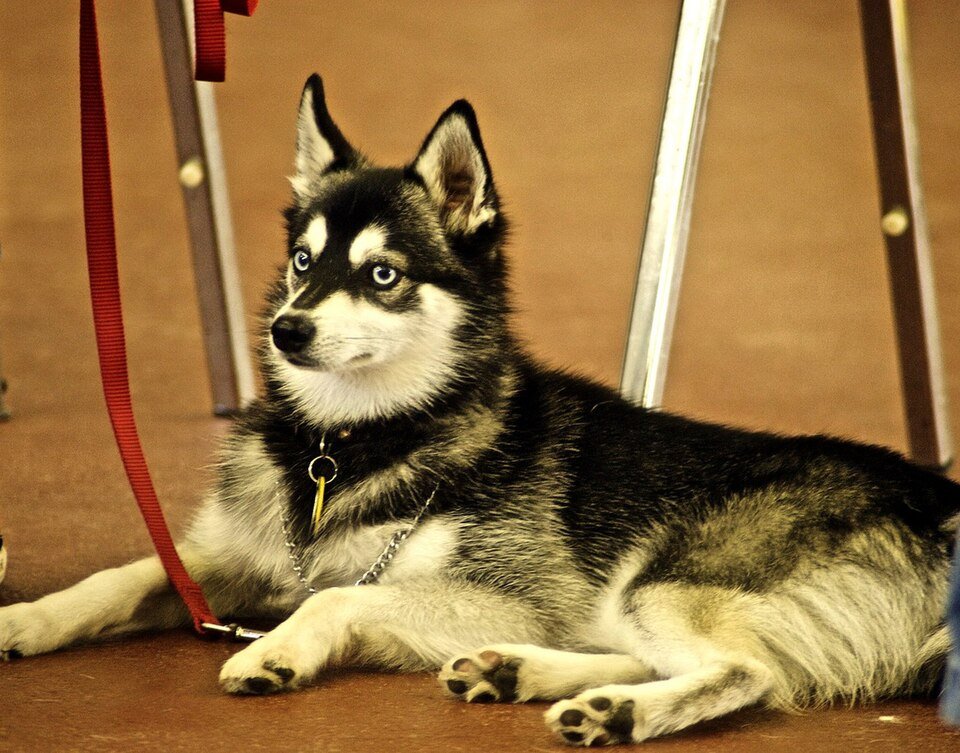
Linda Spurlin and her family developed the Alaskan Klee Kai in Alaska beginning in the 1970s, selecting a companion-sized dog from husky-type foundations. Its size and facial markings do not make it a scaled-down sled team. Three size varieties exist, while the breed's development emphasized a distinctive companion with northern ancestry.
Temperament and training
A Klee Kai may be animated with familiar people and cautious about strangers. Reward voluntary investigation and avoid passing the dog between unfamiliar hands. Practice secure door routines and a recall inside an enclosure; a quick, curious dog may find gaps that look too small to matter. Teach gradual, comfortable time apart rather than assuming a small companion automatically tolerates absences.
Daily needs & enrichment
Mix exploratory walks with easy scent searches, trick training, or suitable agility foundations. Follow the dog's confidence on new equipment instead of lifting it into a challenge. Check enclosures for climbing and squeezing opportunities, and protect small animals from chase games. Short bouts of varied engagement with pauses can be more useful than expecting a small dog to exercise itself indoors.
Coat care
Comb through the dense undercoat as well as the longer guard hairs, with extra attention when the coat blows. A tool that cuts the guard hairs is different from one that loosens dead undercoat. Keep grooming sessions comfortable, and dry thoroughly after a bath. Expect substantial loose hair even from a small dog; a naturally neat appearance does not mean the undercoat needs no work.
Brush and comb at least weekly, adding more frequent gentle sessions during undercoat release. The registry advises avoiding bladed grooming tools. Bathe occasionally for dirt, rinse fully, and dry to the roots with comfortable airflow; routine body shaving is unnecessary.
Living Environment & Daily Needs
Provide play, walks, and a quiet place to withdraw from unfamiliar activity. Give an Alaskan Klee Kai time with new people, and account for coat care as well as engagement when planning a compact dog's routine.
Care through life stages
Puppies need voluntary introductions and comfortable handling without being passed between strangers. Adults need active play and gradual separation practice. Seniors may need easier access and shorter care sessions; unusual bleeding, fainting, vision changes, or a skipping gait needs assessment.
Frequently asked questions
Does a CHIC number mean all Klee Kai results were normal? No. It records the required screening and public disclosure. Read the actual reports and ask separately about optional Factor VII testing and follow-up clinical checks.
Questions to ask before choosing a dog
Which size variety is expected, and what is the adult dog's observed size rather than a promise of an unusually tiny puppy? Ask how this individual handles visitors, being apart, and grooming during shedding. Review patellar, cardiac, eye, and thyroid records and clarify any Factor VII test. Inspect everyday doors and fencing from the perspective of a small, agile escape artist.
Plan care for the individual dog
Budget, time alone and household compatibility depend on the individual dog and your circumstances. Use our care budget guide, time-alone planning guide and questions before adopting alongside the breed-specific source information above.
Health questions for a veterinarian
The breed club recommends patellar, cardiac, specialist eye, and thyroid evaluations; its 2024 statement lists Factor VII deficiency DNA testing as optional. Patellar luxation involves a kneecap slipping from its normal position, while Factor VII deficiency concerns blood clotting and can matter before surgery even when a dog looks well. Ask for the actual result and tell the veterinarian about abnormal bleeding. A CHIC number means the required screening information was completed and disclosed; it does not mean every result was normal. Eye and thyroid findings can also change over time. Skipping on a hind leg, fainting, unusual bleeding, or new visual difficulty deserves clinical assessment rather than reassurance based on small size.
Updated October 25, 2026. General information; see our Editorial Policy for sourcing and review practices.