Ranges describe the registry profile, not a measurement, life expectancy, or health prediction for a particular dog. Separate sex or variety ranges are preserved where the source supplies them.
Source characteristics at a glance
The registry uses an ordinal 1–5 scale. A higher number indicates more of the named trait, not a better dog or a compatibility score. These descriptions are general and are not clinical measurements.
History and original work
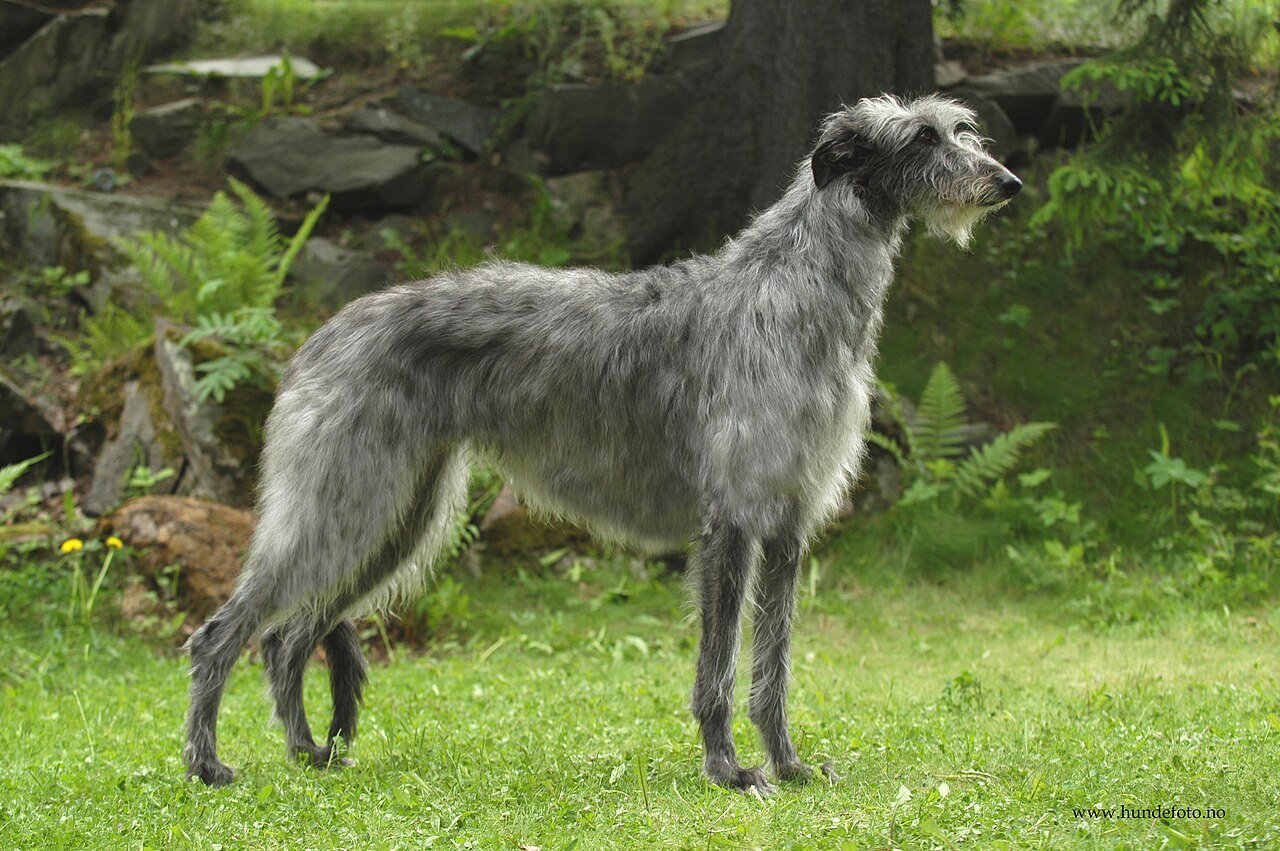
The Scottish Deerhound developed in Scotland for pursuing red deer across demanding terrain. Its earliest ancestry includes legend as well as historical accounts, so precise ancient founding dates are uncertain. The large rough-coated sighthound still needs safe running and close household company.
Training & behavior
Teach a calm doorway wait and loose-lead walking with gentle rewards. Practice settling on a generously sized bed and cooperative handling before the youngster is difficult to lift or steady. Use boundaries around moving small animals; a quiet indoor manner does not remove pursuit interest.
Daily needs & enrichment
Provide secure room for self-paced running and appropriate compatible play, alongside gradually conditioned walks. Avoid forced running beside a bicycle during growth. Maintain comfortable activity into later life while adapting to mobility and recovery, rather than letting a resting adult become completely inactive.
Coat care
Brush and comb the harsh coat about weekly, checking ear bases, elbows, groin, legs, and the tail for debris or knots. A gentle slicker followed by a metal comb can reach longer rough hair. Run your hands over the large body to notice a new lump or tender spot.
Bathe when needed with dog shampoo, rinse fully, and dry the skin and longer hair with towels and comfortable airflow. Routine sculpting or body clipping is unnecessary. Keep nails suitable for a secure gait. Avoid rough pulling at fine ear hair and leaving damp, compacted sections against the skin.
Living Environment & Daily Needs
Check generous resting space, household routes, and transport for a very large Deerhound. Secure opportunities to stretch out and dependable handling around pursuit remain important even with a moderate everyday activity pattern.
Practical question
Should bleeding-test information wait until a problem appears after surgery?
No. Give the team the actual Factor VII and DEPOH results before a procedure so risk can be assessed and a plan made in advance.
Plan care for the individual dog
Budget, time alone and household compatibility depend on the individual dog and your circumstances. Use our care budget guide, time-alone planning guide and questions before adopting alongside the breed-specific source information above.
Health questions for a veterinarian
The club recommends Factor VII deficiency and delayed postoperative hemorrhage testing, cardiac evaluation, and bile acid screening for liver shunt. Share bleeding results with the veterinary team before procedures; delayed bleeding can occur after an initially uneventful operation. These checks do not exclude cardiomyopathy, bone cancer, or every surgical complication. Persistent focal lameness or fainting needs assessment. Unproductive retching, abdominal swelling, or collapse can signal gastric dilatation-volvulus and requires emergency care immediately.
Editorial update: October 24, 2026. General information; individual care requires veterinary assessment. No veterinary review is claimed. See our Editorial Policy for sourcing and review practices.