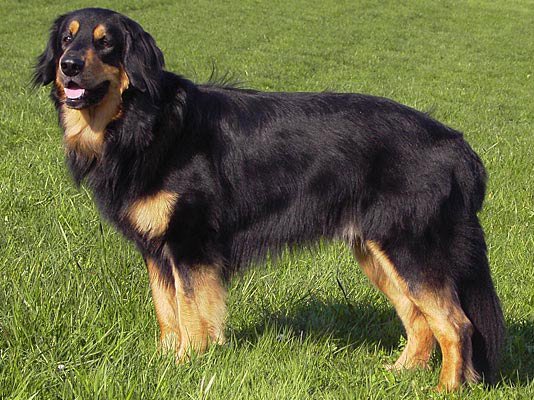
Ranges describe the registry profile, not a measurement, life expectancy, or health prediction for a particular dog. Separate sex or variety ranges are preserved where the source supplies them.
Source characteristics at a glance
The registry uses an ordinal 1–5 scale. A higher number indicates more of the named trait, not a better dog or a compatibility score. These descriptions are general and are not clinical measurements.
History and original work
The Hovawart is a German working dog whose name refers to guarding a farm or homestead. The modern breed was reconstructed through twentieth-century selection of suitable farm dogs and crosses. Its history supports purposeful work and a watchful outlook, rather than an assumption that guarding requires aggressive training.
Training & behavior
Teach a calm station behind a barrier when visitors enter and reward checking with you before approaching. Introduce new situations at a manageable distance, without asking strangers to crowd the dog. Use searches and clear reward-based lessons. Discourage rehearsed boundary charging instead of treating it as a useful household duty.
Daily needs & enrichment
Tracking, scent discrimination, conditioned hikes, and rally offer meaningful shared tasks. Build duration and terrain gradually, particularly for a growing dog. A yard supports activity but does not replace work with a person. Include quiet recovery so alert observation does not become continuous patrol of the household.
Coat care
Brush and comb the longer coat about weekly, adding sessions during shedding. Check behind the ears, chest, under elbows, belly, and trousers; the comparatively modest undercoat does not prevent knots in friction areas. Remove burrs after exploration and separate small tangles gently from their ends.
Bathe when dirty, rinse dog shampoo fully, and dry the feathered areas to the roots with towels and gentle airflow. A natural outline with limited foot or sanitary tidying is appropriate; routine close body clipping is unnecessary. Avoid pulling ear mats or assuming a numerical grooming score replaces a hands-on skin and coat check.
Living Environment & Daily Needs
A Hovawart's protective outlook calls for clear household expectations and thoughtful introductions. Scent games and steady teaching can support purposeful engagement, while a quiet resting place accompanies rather than replaces active time with people.
Practical question
Should visitors make friends by approaching and touching the dog immediately?
No. Give space, manage the entrance, and reward relaxed behavior; voluntary interaction can develop without forcing a protective dog into close contact.
Plan care for the individual dog
Budget, time alone and household compatibility depend on the individual dog and your circumstances. Use our care budget guide, time-alone planning guide and questions before adopting alongside the breed-specific source information above.
Health questions for a veterinarian
Hip evaluation is an important breeding consideration, but normal parental reports cannot guarantee normal joints in every puppy. Reliable breed-wide frequencies for other conditions are limited; request documented family history rather than accepting claims that no inherited disease exists. Persistent lameness, unexplained stiffness, changing stamina, or recurrent skin and ear problems should be examined. Keep body condition lean and develop activity progressively instead of using a reputation for robustness to justify excessive loading.
Editorial update: October 24, 2026. General information; individual care requires veterinary assessment. No veterinary review is claimed. See our Editorial Policy for sourcing and review practices.