If your dog won’t use pee pads, start with the setup: offer a large, stable pad in a quiet, accessible spot, guide your dog there at likely bathroom times, and reward immediately after they finish. Dogs may avoid pads because the surface is unfamiliar, the location is inconvenient, or the lesson is unclear. A different brand alone rarely fixes the whole problem.
First separate a training difficulty from a health change. A dog who suddenly urinates more often, seems uncomfortable, or loses previously reliable habits needs veterinary advice. Repeated straining with little or no urine requires immediate veterinary care. Do not wait to try another pad.
This guide focuses on dogs who avoid an indoor pad. For broader accident patterns, see our complete guide to dogs peeing in the house.
Why Your Dog Won’t Use Pee Pads
The surface does not match what your dog learned
Dogs can develop preferences for where they eliminate and what is under their paws. An adult accustomed to grass may not recognize a flat disposable sheet as a bathroom. Meanwhile, a puppy may repeatedly choose a rug because that location or texture has become familiar.
Watch what happens before assuming your dog dislikes every pad. Do they step on it comfortably, circle beside it, or avoid a raised tray edge? These observations suggest changes to test; they do not establish a diagnosis. Introduce an unfamiliar surface calmly, without holding your dog on it.
The location or footprint makes success difficult
A pad beside a noisy washer, behind a closed door, or across a slippery floor can be hard to use. Placing it beside bedding or food also makes the bathroom area less distinct. Choose a quiet spot that remains available throughout the day.
Check the whole dog, not just the front paws. A puppy can stand partly on a small pad while urinating beyond its edge. The absorbent center may be smaller than the package dimensions. A larger target or a suitable stable holder may help with aiming and movement.
Timing, smells, and past experiences get in the way
A puppy cannot learn from opportunities that arrive after the bladder is already empty. Delayed rewards, changing locations, and unsupervised wandering can also blur the lesson. Punishment may make a dog reluctant to eliminate while you watch.
A soiled pad or unfamiliar fragrance is another variable to consider. Do not assume scent explains every refusal, or that a scented attractant guarantees use. If avoidance began after a product change, try returning to the familiar setup while keeping other factors steady.
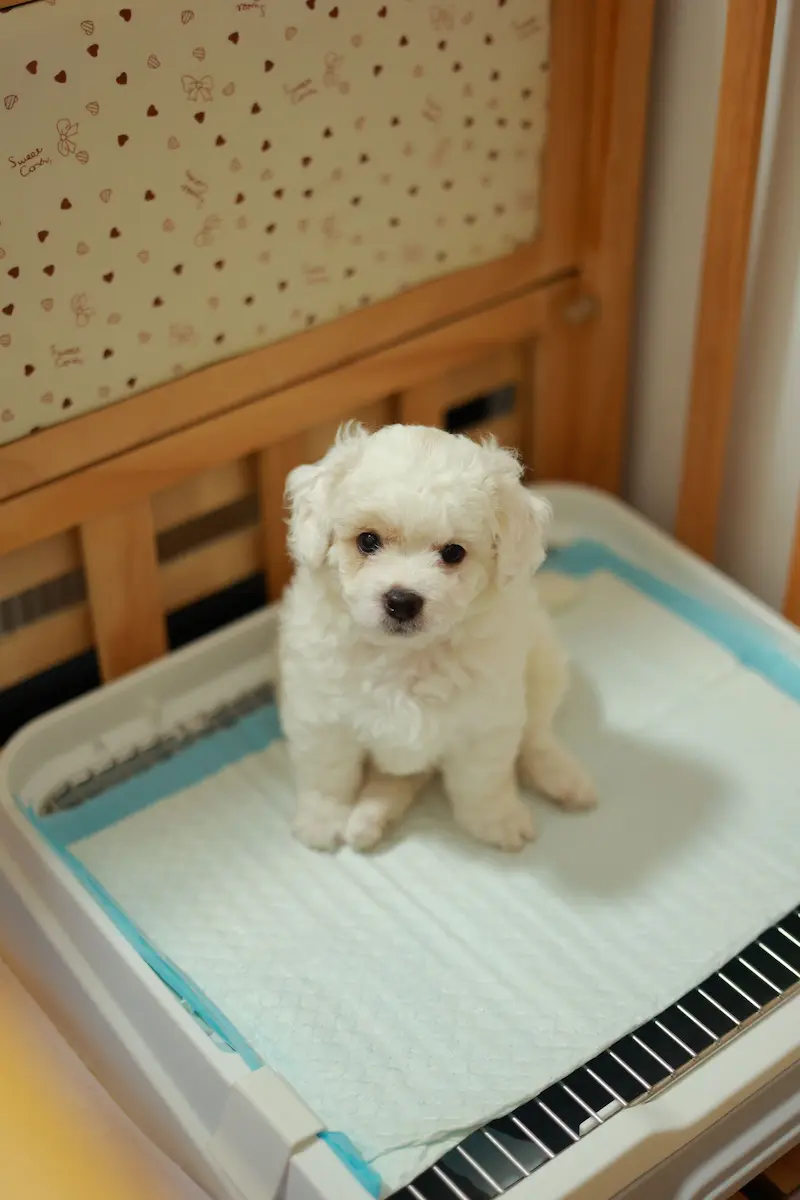
How to Teach Your Dog to Use a Pee Pad
1. Make one bathroom area easy to find
Lay the pad flat with its absorbent side up, following the package instructions. Keep a clear route and enough room for your dog to turn. Separate the toilet from meals and rest. Remove nearby washable rugs temporarily if they repeatedly attract accidents.
A comfortable gated area or pen can make supervision more manageable. It still needs appropriate space, enrichment, and care. Our guide to crates, exercise pens, and open beds explains the different purposes of those setups. Confinement cannot replace necessary bathroom opportunities.
2. Offer chances before the usual accident
Take your dog to the pad after waking, meals, drinking, and active play, with additional chances between those events. Young puppies need particularly frequent opportunities, sometimes during the night. Adjust to the individual rather than treating an age formula as a holding-time requirement.
Keep a brief log of waking, successful toileting, and accidents. If a puddle usually appears shortly after a nap, arrange the next opportunity immediately when your puppy wakes. Maintain normal access to fresh water; changing the bathroom schedule is preferable to restricting drinking.
3. Stay nearby and reward the finished behavior
Accompany your dog calmly and allow a few quiet minutes. Avoid hovering, repeatedly commanding, or distracting them with play. Once elimination finishes, offer calm praise and a small treat right at the bathroom area. Keep rewards ready, safely beyond your dog’s reach.
You can introduce a quiet phrase such as “Go potty” as your dog begins. Later it may become a useful cue. If nothing happens, return to close supervision and try again soon. An attempted bathroom visit does not establish that your puppy no longer needs to go.
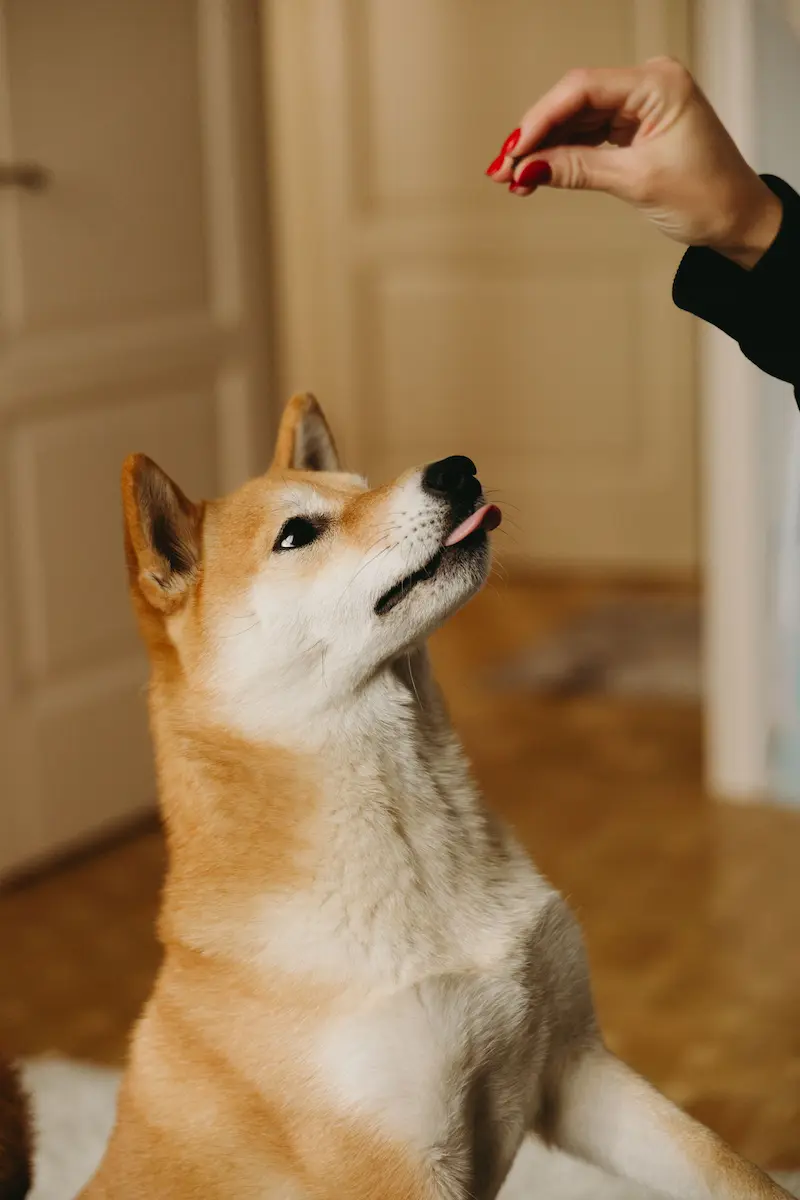
4. Repeat the same lesson across the household
Agree on the location, cue, and reward timing. Record whether the last visit actually produced urine. For example, “Pad at 9:10, peed, rewarded” is more useful than “I took him over there.” Expand supervised access gradually as the pattern becomes dependable.
A newly adopted adult also needs to learn your home’s rules. Previous training may have involved another surface or unrestricted outdoor access. Our first-week home guide can help you build a predictable arrival routine without demanding immediate reliability.
What to Do When Pee Pad Training Isn’t Working
Peeing beside the pad: check whether the rear end extends beyond it. Try a larger target in the same place, keeping the surface flat. Reward actual elimination on the pad rather than simply standing on it.
Using it sometimes: look for missed transition breaks, a dirty surface, blocked access, or inconsistent supervision. Change one variable at a time and compare the next several opportunities. One accident does not prove a brand has failed.
Accidents elsewhere: clean the affected area with an appropriate urine cleaner, following its surface and contact-time directions. Keep pets away until the label says the area is safe. Never mix cleaning chemicals. Quietly clean a discovered puddle; scolding afterward does not teach the alternative.
Tearing or eating pads: remove access to loose pads when you cannot supervise. A compatible holder may reduce movement, but it does not make the pad chew-proof. Do not automatically substitute towels or other swallowable materials. Discuss a safer toilet arrangement with your veterinarian or qualified reward-based trainer.
If material may have been swallowed, contact your veterinarian promptly for advice. Vomiting, abdominal pain, marked lethargy, or difficulty passing stool increase concern. Do not induce vomiting or wait for symptoms before seeking guidance about a suspected ingestion.
How to Choose the Right Pee Pad for Your Dog
Start with usable area. Measure your space and watch your dog’s stance. Package width includes borders that may not absorb like the center. Bigger dogs and dogs who circle widely may need more coverage than a regular square offers.
Then consider stability and absorption. A waterproof backing protects beneath the pad; it cannot catch urine that misses the edge. Layer counts and “quick-dry” claims describe product design, not directly comparable laboratory results. Replace wet or soiled pads promptly instead of treating advertised maximum durations as a schedule.
Separate fragrance from attractants. A lavender scent, a charcoal layer, and a training attractant serve different advertised purposes. None teaches the routine by itself. An unscented product can be a reasonable starting point when you are investigating odor-related avoidance, although “unscented” does not necessarily mean no attractant.
Finally, consider ongoing replacement and waste. Disposable pads require replenishment and are not washable. Compare the current cost per pad yourself, alongside size and replacement frequency. A large pack is useful only if its pad actually fits your dog’s needs.
5 Puppy Pee Pads Worth Considering
Affiliate disclosure: As an Amazon Associate I earn from qualifying purchases. MyPupwise may receive a commission from qualifying purchases through the links below.
These are specification-based options, not results of hands-on testing by MyPupwise. Product details reflect the linked listings reviewed for this guide; check the selected size and pack before ordering. We compare footprint, construction, scent, and practical fit rather than award an unsupported overall winner. No pad guarantees successful training.
On smaller screens, scroll the table sideways to see every column.
| Product | Main feature | Reviewed size / pack | Consider if | Amazon |
|---|---|---|---|---|
| Amazon Basics | Five layers; gel-forming core | 22 × 22 in; 100 pads | You want a regular everyday pad | View product |
| COCOYO | Polymer core; polyethylene backing | 22 × 22 in; 30 pads | You prefer a smaller starter pack | View product |
| Glad for Pets | Activated carbon; six layers | 23 × 23 in; 100 pads | You are considering charcoal odor management | View product |
| BV | Six layers; built-in attractant | 22 × 22 in; 100 pads, Standard | You want a regular multilayer option | View product |
| Hartz Home Protection | Lavender scent; FlashDry technology | 21 × 21 in; 50 pads | Your dog tolerates a scented setup | View product |
1. Amazon Basics Leak-Proof Dog and Puppy Potty Training Pee Pads
The reviewed Regular variant contains 100 pads measuring 22 × 22 inches overall, with a listed 19 × 19-inch absorbent center. Amazon describes five layers, a quick-dry surface, a gel-forming core, plastic backing, and a built-in attractant.
This is an everyday option when that footprint suits your dog. The smaller center matters if your puppy aims near an edge. Other pack counts are listed, but verify the selected variant. The attractant is a product feature, not evidence your dog will learn faster. See available options on Amazon.
2. COCOYO Best Value Training Pads, 30 Count
The linked ASIN currently displays COCOYO, with a 30-count pack of 22 × 22-inch pads. Its description identifies a nonwoven surface, tissue, polymer-and-fluff absorbent core, attractant, and polyethylene backing. The listing describes five-layer construction, although one bullet inconsistently refers to four lining layers.
The smaller pack may suit an initial trial before committing to more pads. “Best Value” is part of the product name, not our price ranking. We cannot resolve the layer wording independently, so do not choose this option on layer count alone. View the COCOYO product on Amazon.
3. Glad for Pets Activated Carbon Puppy Pads
The reviewed Large pack has 100 pads measuring 23 × 23 inches. Glad’s listing describes six layers, activated carbon for odor control, a polymer layer, a polyethylene bottom liner, and a pheromonal attractant.
Consider it if charcoal odor management is a feature you want to try. It is not proof that odors disappear completely or that every dog prefers the surface. Advertised absorption speeds and protection durations have not been verified by MyPupwise; change soiled pads according to actual conditions. Check Glad pads on Amazon.
4. BV Puppy Pads, Standard 100 Count
The Standard variant lists 100 pads at 22 × 22 inches. BV advertises a six-layer design, waterproof liner, rapid-dry sheet, odor control, and built-in attractant. Charcoal variants also appear, so check that the selected option matches your intended purchase.
This is another regular-size multilayer option rather than an independently demonstrated upgrade over five-layer pads. Its listed capacity does not establish real-world performance against the other products. It also will not solve a bathroom target that is too small for your dog’s stance. View BV pads on Amazon.
5. Hartz Home Protection Lavender Scented Dog Pads
The linked variant contains 50 pads measuring 21 × 21 inches. Hartz advertises thicker quilting, FlashDry liquid-to-gel technology, plastic backing and borders, and lavender-scented odor management. Other quantities are separate selections.
Consider this scented option only if fragrance fits your household and your dog’s response. It is not the first variable to add when you suspect odor-related avoidance. The reviewed footprint is smaller than the other four, and lavender is not universally preferred. Manufacturer odor and leak claims are not guarantees. Check Hartz pads on Amazon.
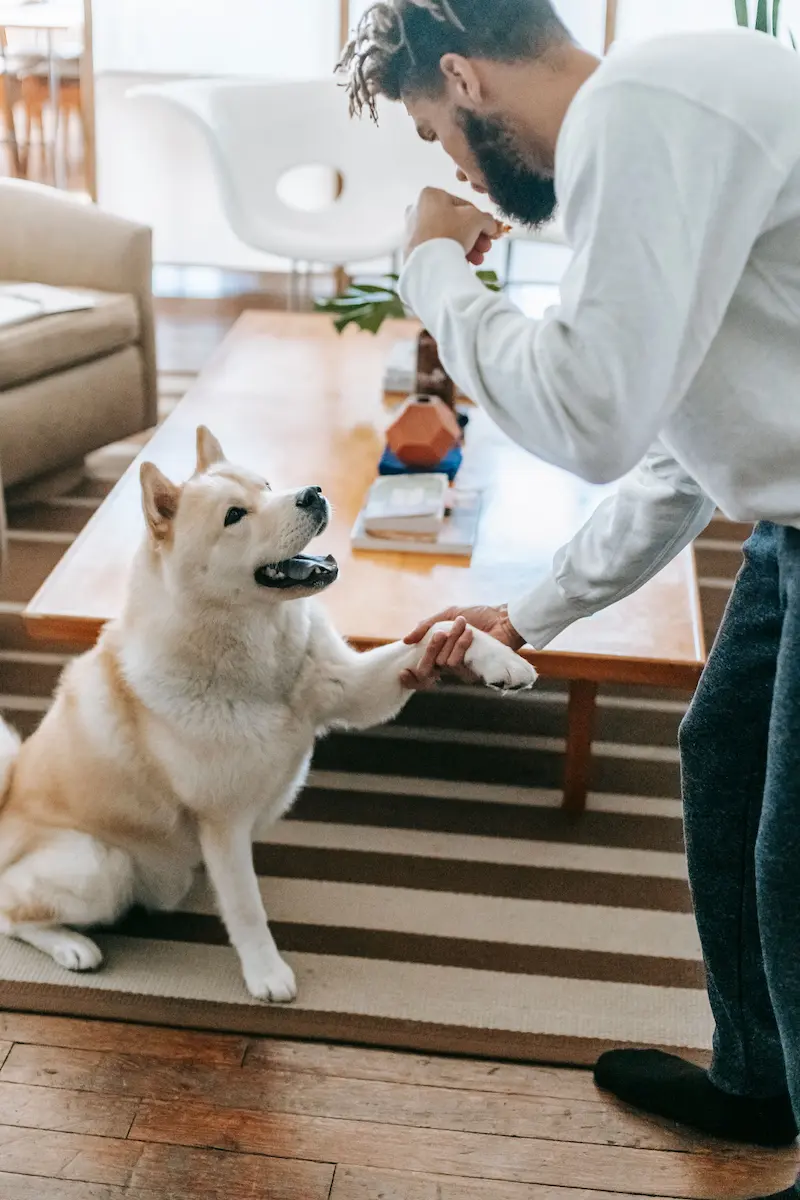
When to Try a Different Potty Training Setup
A pad is a tool, not a requirement. A natural-grass or artificial-turf toilet may be worth considering for a dog familiar with grass. Check drainage, cleaning needs, chewing risk, and accessible edges. Natural grass needs replacement; artificial turf needs thorough maintenance. Neither is automatically safer for a dog who eats materials.
If outdoor toileting is your goal, introduce a consistent outdoor spot and reward success there. Keep enough bathroom opportunities during the transition. A high floor adds travel time, so our high-rise potty training guide can help you plan for elevators and building access. Ask your veterinarian about suitable outdoor exposure for a young puppy.
When a Vet Visit May Be Necessary
Arrange veterinary assessment for sudden changes, blood in urine, discomfort, frequent small urinations, increased thirst, or leakage during sleep. Mobility problems may also make reaching a pad difficult. Avoid assuming an older dog is simply forgetting the rules.
Repeated attempts to urinate with little or no output need immediate veterinary care because a blockage is possible. Call an emergency clinic if your regular veterinarian cannot see your dog promptly. A pad’s color or absorbency cannot rule out urinary disease, and training should never delay care.
Frequently Asked Questions
Why won’t my puppy pee on the pad but will pee next to it?
The target may be too small, or your puppy may have learned the location without the exact surface. Check their rear-end position, enlarge the usable target, and reward finishing on it. Sudden frequency or discomfort warrants veterinary advice.
Should I put several pads around the house?
Begin with a clear, accessible bathroom area. Additional planned stations may be needed in a large home, but scattering pads everywhere can make the intended destination less clear. Match access to your dog’s current needs.
Do attractants make dogs use puppy pads?
Some products contain attractants, but that does not guarantee an individual dog’s response. Timing, supervision, location, and immediate rewards remain necessary. Avoid repeatedly adding sprays when you have not identified why the current setup fails.
Can an adult dog learn to use pee pads?
Yes. Introduce the new surface and location gradually, offer frequent opportunities, and reward success. Previous outdoor habits may require adjustment. Investigate new accidents or physical difficulties with your veterinarian rather than treating them as disobedience.
How often should I change a pee pad?
Inspect it regularly and replace it when wet, soiled, damaged, or avoided. Follow the product instructions, but do not use advertised capacity or maximum hours as permission to leave your dog with an unpleasant bathroom surface.
How long does pee pad training take?
There is no universal deadline. Age, health, past learning, access, and consistency affect progress. Track successful uses and recurring problems. If a carefully managed plan is not improving, seek veterinary or qualified reward-based training support.
Final Thoughts
When your dog won’t use pee pads, simplify the next opportunity: a reachable spot, enough usable surface, calm guidance, and a reward after finishing. Choose products around that plan. Change one variable at a time, prevent chewing, and get veterinary help for sudden changes or urinary warning signs.
General guidance does not replace individual veterinary or behavior assessment.