Ranges describe the registry profile, not a measurement, life expectancy, or health prediction for a particular dog. Separate sex or variety ranges are preserved where the source supplies them.
Source characteristics at a glance
The registry uses an ordinal 1–5 scale. A higher number indicates more of the named trait, not a better dog or a compatibility score. These descriptions are general and are not clinical measurements.
History and physical characteristics
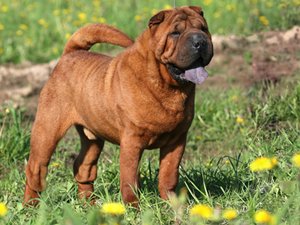
The Shar-Pei comes from southern China, where versatile farm dogs performed hunting, herding, and guarding work. Surviving dogs in Hong Kong and Taiwan contributed to its preservation as numbers declined on the mainland. International interest grew after an appeal by breeder Matgo Law in the 1970s.
The broad muzzle, small folded ears, bristly coat, and loose skin are characteristic. More extreme wrinkling is not evidence of better quality or health. Choose a dog whose eyes, skin, movement, and breathing can be assessed comfortably, rather than selecting by the amount of skin alone.
Temperament and training
A Shar-Pei may prefer a small social circle. Teach comfortable face, ear, and foot handling early, alongside calm visitor routines and leash skills. Give newcomers space instead of forcing contact. Supervise children and animal introductions rather than interpreting attachment to family as universal sociability.
Daily needs & enrichment
Provide exploratory walks and rewarding lessons that do not rely on endless repetition. Offer a quiet place to withdraw from household activity. Watch comfort in warm conditions and adjust outings to the dog; physical exercise alone does not resolve uncertainty around unfamiliar people.
Coat care
Give the short coat a gentle weekly pass with a soft brush or grooming mitt, adjusting for the actual coat length and shedding. Inspect folds, feet, and equipment contact areas daily without repeatedly scrubbing healthy skin. Ask a veterinarian to demonstrate a cleaning and drying routine for folds or narrow ear canals that need care.
A bath about monthly may suit some dogs; adjust it to dirt and the veterinarian's plan if skin disease is present. Rinse dog shampoo fully and dry folds with towels or comfortable airflow. Avoid hot drying, routine body shaving, and treating a bristly coat like a wire terrier that needs stripping. Do not put cotton swabs, peroxide, powders, or unprescribed medication into ears or folds.
Living Environment & Daily Needs
Give a Shar-Pei predictable household boundaries and patient social introductions. Its selective welcome should inform visitor arrangements, while a quiet resting area and consistent guidance help organize ordinary encounters in any home setting.
Care through life stages
Teach puppies that face, ear, and foot handling can be brief and rewarding. Reassess skin and eyelid comfort during growth rather than waiting for a cosmetic concern to become painful. In adults and seniors, keep records of unexplained fever, swelling, thirst, or appetite changes and discuss them with a veterinarian.
Frequently asked questions
Should every skin fold receive medication? No. Healthy skin does not need treatment simply because it is wrinkled. Ask for an individual care demonstration and seek assessment of persistent moisture, odor, redness, or pain rather than trying stronger cleaning products.
Questions to ask before choosing a dog
Has this dog or its family had unexplained fever, swollen joints, kidney problems, or eyelid surgery? Ask for hip, elbow, patella, eye, and thyroid records. Observe responses to face handling and visitors without pressuring the dog.
Plan care for the individual dog
Budget, time alone and household compatibility depend on the individual dog and your circumstances. Use our care budget guide, time-alone planning guide and questions before adopting alongside the breed-specific source information above.
Health questions for a veterinarian
Shar-Pei autoinflammatory disease (SPAID) can involve recurrent fever and inflammation and may be associated with amyloidosis. A genetic risk-marker result does not establish an individual diagnosis or exclude other inflammatory disease. Record episodes and seek veterinary assessment for unexplained fever or swelling rather than assuming every episode has the same cause.
The breed club lists hip and elbow screening, patellar evaluation, thyroid assessment, and clinical eye examination. These address joint development, kneecap stability, thyroid disease, and eye abnormalities; they do not rule out SPAID or all skin and ear disease. Ask about eyelid procedures and kidney illness in relatives as well as test reports. Squinting or a painful eye needs prompt attention, and persistent skin or ear discomfort warrants assessment.
Updated October 25, 2026. General information; see our Editorial Policy for sourcing and review practices.