Ranges describe the registry profile, not a measurement, life expectancy, or health prediction for a particular dog. Separate sex or variety ranges are preserved where the source supplies them.
Source characteristics at a glance
The registry uses an ordinal 1–5 scale. A higher number indicates more of the named trait, not a better dog or a compatibility score. These descriptions are general and are not clinical measurements.
History and physical characteristics
The Cavalier was developed in Britain by reviving a longer-faced style of toy spaniel depicted in older portraits. Breeders working in the 1920s helped establish the modern breed. It is distinct from the more flat-faced English Toy Spaniel, also called the King Charles Spaniel in Britain.
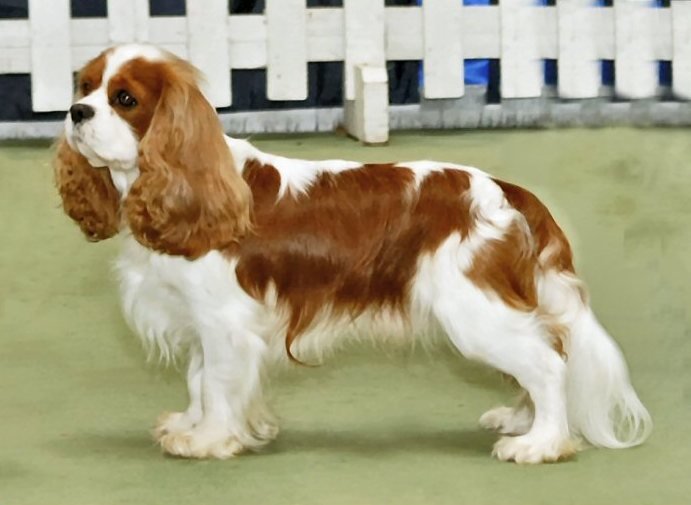
Silky feathering, drop ears, and an expressive face accompany a small spaniel body. The four recognized color patterns have their own names, including Blenheim and Ruby, but color does not establish temperament, health, or a different care standard.
Temperament and training
A Cavalier's interest in people can make gentle teaching rewarding, but it still needs confidence away from constant attention. Practice brief, comfortable separations and relaxed greetings. Its spaniel background may appear when birds or small animals move; use secure outings and supervise family interactions even with an affectionate dog.
Daily needs & enrichment
Mix sniffing walks, small retrieving games, and easy learning tasks with restful company. Let the actual dog's stamina guide the pace. A Cavalier with a heart murmur, breathing change, or pain needs a veterinary exercise plan rather than either enforced inactivity or a fixed daily distance.
Coat care
Brush and comb the silky coat several times weekly, checking ear feathering, under elbows, belly, legs, and the collar line for knots. Support the roots and work from the ends of a small tangle instead of pulling. Check ears at least weekly and after wet outings, using only an individual cleaning routine if one is needed.
Bathe occasionally for dirt with dog shampoo, rinse completely, and dry the feathering and roots with gentle airflow. Modest foot or sanitary tidying can be discussed with a groomer; routine body shaving is unnecessary. Avoid scissors beneath tight mats, inserting cotton swabs into ear canals, and holding the head firmly to work through pain. Persistent head shaking or discomfort needs veterinary assessment.
Living Environment & Daily Needs
Make walks, play, and patient lessons part of a Cavalier's day alongside quieter companionship. Check comfortable rest and bathroom access for the individual, and include coat checks rather than assuming small size reduces everyday care.
Care through life stages
Puppies need gentle handling, supervised exploration, and gradual practice being comfortable away from constant attention. Adult activity should reflect actual stamina and any cardiac or pain findings. Keep grooming comfortable for seniors and reassess new coughing, fatigue, unusual scratching, or reluctance to move rather than assuming a quiet dog is simply aging.
Frequently asked questions
Does an affectionate Cavalier automatically cope well with absences? No. Ask what has been observed during separations in a home and practice brief, comfortable absences while arranging dependable care. Enthusiastic greetings do not establish how the dog felt while alone.
Questions to ask before choosing a dog
How recent is the cardiologist's report, and what did it assess? Request eye, hip, and patella records and family history of heart or neurological disease. Ask about unusual scratching, pain, and how this dog manages separations and ordinary handling.
Plan care for the individual dog
Budget, time alone and household compatibility depend on the individual dog and your circumstances. Use our care budget guide, time-alone planning guide and questions before adopting alongside the breed-specific source information above.
Health questions for a veterinarian
Mitral valve disease is a major Cavalier concern. Request a dated cardiologist report and discuss when follow-up is due; a previous normal result does not exclude disease later in life. The breed club recommends ongoing cardiac assessment. Clinical eye examinations, hip imaging, and patellar evaluation address separate inherited eye and joint concerns and should be reviewed as actual reports rather than a checklist marked complete.
Chiari-like malformation and syringomyelia also warrant discussion, particularly with unexplained neck pain, unusual scratching, or altered movement. Those signs have other possible causes and do not diagnose the condition at home. MRI is a specialist investigation, not a replacement for examination or a universal requirement for every pet. Ask about targeted DNA tests relevant to family history, including episodic falling or dry-eye/curly-coat syndrome. Breathing difficulty or collapse requires urgent care; changes in coughing, stamina, or comfort deserve veterinary assessment.
Updated October 25, 2026. General information; see our Editorial Policy for sourcing and review practices.