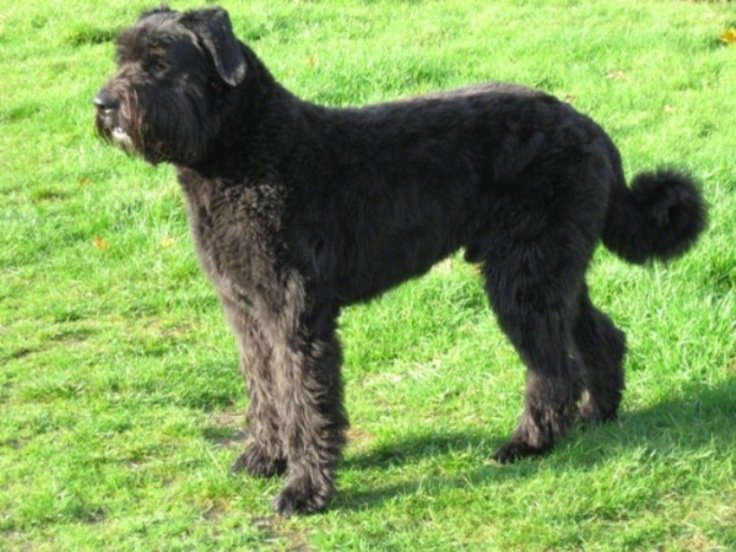
Ranges describe the registry profile, not a measurement, life expectancy, or health prediction for a particular dog. Separate sex or variety ranges are preserved where the source supplies them.
Source characteristics at a glance
The registry uses an ordinal 1–5 scale. A higher number indicates more of the named trait, not a better dog or a compatibility score. These descriptions are general and are not clinical measurements.
History and original work
The Bouvier des Flandres developed in Flanders, a region spanning parts of present-day Belgium and France. Moving cattle was central to its work, but farms also used these versatile dogs for guarding and pulling carts. Wartime service further drew on their strength and trainability. The coarse coat and substantial frame belong to a working farm dog, not a low-maintenance shaggy ornament.
Training & behavior
Teach a light leash response, a reliable stop at doors, and moving away from a person on cue before adult strength makes mistakes difficult. Reward calm observation of visitors from a station, using gates to prevent rushing. Redirect attempts to chase or control children into a separate task. A Bouvier can enjoy work with its family without being given responsibility for supervising children or deciding who may enter.
Daily needs & enrichment
Provide purposeful walks, tracking, rally, or age-appropriate carting instruction once physically ready. Teach the underlying skills without adding heavy loads to a growing dog. A search for a hidden object or a controlled retrieve can occupy the mind on days when long outings are impractical. Watch recovery in warm weather under the dense coat and let resting behavior become part of the working routine.
Coat care
Brush once or twice a week with a pin brush or slicker, lifting the rough outer coat to reach the thick undercoat. Use a large comb to check the legs, elbows, collar area, and beard after brushing. Wipe food and water from the beard, then dry it; a clean-looking outer fringe can conceal knots and damp skin.
Periodic trimming keeps the coat practical, especially around the eyes, feet, and sanitary areas. Remove manageable tangles before a bath, use dog shampoo, and rinse all the way through the dense coat. Towel-blot and dry in sections with cool moving air before combing again. Do not let a heavy wet coat remain packed against the body, or cut close to hidden skin when trying to remove a mat. A shorter pet trim still needs regular comb checks.
Living Environment & Daily Needs
Plan workable household routes and considerate handling for a substantial Bouvier des Flandres. Regular training and activity should sit alongside coat maintenance and a comfortable resting space for this watchful working dog.
Practical question
Will a shorter beard stay clean without attention?
Less length can reduce debris, but food and water still collect around the muzzle. Wipe and dry the area, and check the skin if odor, redness, or repeated rubbing develops.
Plan care for the individual dog
Budget, time alone and household compatibility depend on the individual dog and your circumstances. Use our care budget guide, time-alone planning guide and questions before adopting alongside the breed-specific source information above.
Health questions for a veterinarian
The American club's June 2026 statement recommends hip and elbow imaging, a cardiac evaluation, and ophthalmologist examinations. A large working dog may keep moving despite discomfort, so stiffness, reluctance to rise, or a changed stride deserves assessment. Sudden unproductive retching with abdominal swelling or distress is an emergency because gastric dilatation-volvulus can occur in deep-chested dogs. Keep a record of illnesses in relatives as well as screening results; a normal examination cannot exclude every later neurologic, hormonal, or other disease.
Editorial update: October 24, 2026. General information; individual care requires veterinary assessment. No veterinary review is claimed. See our Editorial Policy for sourcing and review practices.