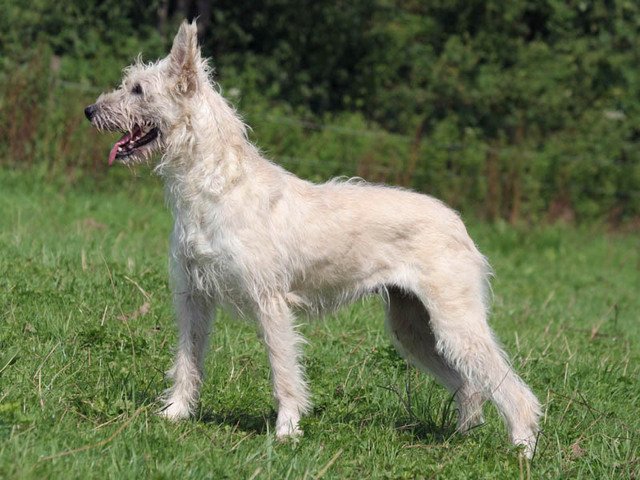
Ranges describe the registry profile, not a measurement, life expectancy, or health prediction for a particular dog. Separate sex or variety ranges are preserved where the source supplies them.
Source characteristics at a glance
The registry uses an ordinal 1–5 scale. A higher number indicates more of the named trait, not a better dog or a compatibility score. These descriptions are general and are not clinical measurements.
History and original work
The Bouvier des Ardennes developed as a cattle-driving and farm dog in Belgium's Ardennes region. Selection favored dogs able to manage livestock in difficult weather and terrain. Numbers fell as traditional farms and herds declined; surviving working lines contributed to later preservation. Its rustic appearance belongs to a practical farm worker, not a smaller version of the Bouvier des Flandres.
Temperament and training
The Ardennes cattle dog's initiative can make repetitive, unrewarding drills unproductive. Give lessons a purpose, reward cooperation, and teach neutrality around visitors instead of encouraging protective responses. Plan animal introductions and supervise children's movement. Working independence needs dependable guidance, not a contest of physical strength.
Daily needs & enrichment
Offer shared activity involving searching, useful skills, and structured games. Vary challenges so an inventive farm dog has reasons to work with you. Teach an end to tasks and comfortable recovery. Outdoor space is useful when someone also organizes safe, meaningful engagement.
Coat care
Work through the harsh outer coat and dense undercoat about weekly with a pin brush and metal comb, increasing attention during shedding. Lift small sections rather than brushing only the surface. Check behind the ears, under the elbows, around the groin, and beneath equipment; gently separate small tangles while supporting the hair at the roots. Clean and dry the beard after meals as needed.
Bathe for actual soiling with dog shampoo, rinse fully, and dry down to the undercoat with comfortable airflow. Preserve the natural rough outline. Do not apply routine hand-stripping or elaborate sculpting borrowed from another wire-coated breed. Avoid scissors beneath tight mats and hot drying; a groomer should assess compacted or painful areas.
Living Environment & Daily Needs
Give an Ardennes cattle dog purposeful exercise and tasks, with clear plans for introductions around its territorial outlook. Household fit depends on managing an active working mind and recovery time, not simply having rugged outdoor surroundings.
Care through life stages
Teach puppies to accept feet, beard care, and calm separation from livestock or running children. Progress adult work through conditioning and planned rest. For older dogs, shorter grooming sessions on a nonslip surface and changes to demanding tasks may help; new stiffness or loss of coordination deserves veterinary attention.
Questions to ask before choosing a dog
Can you show parental hip and elbow reports and any DNA result for the KCNJ10 variant documented in this breed? Ask about early coordination problems in relatives. Observe visitor introductions, purposeful tasks followed by rest, and a grooming demonstration that preserves the rustic coat.
Plan care for the individual dog
Budget, time alone and household compatibility depend on the individual dog and your circumstances. Use our care budget guide, time-alone planning guide and questions before adopting alongside the breed-specific source information above.
Health questions for a veterinarian
A form of inherited spinocerebellar ataxia has been documented in Bouvier des Ardennes puppies and linked to a specific KCNJ10 variant. Ask for the breed-relevant DNA report and neurological history in close relatives. A test labeled only 'ataxia' may address a different variant. Testing that variant does not exclude other causes of poor coordination, and the published cases do not establish a population-wide disease frequency.
Unsteadiness, exaggerated steps, or tremor warrants veterinary examination. Hip and elbow screening of breeding dogs is also recommended in the registry's breed guidance. Request identifiable parental reports: joint imaging evaluates a different question from a DNA test, and normal parental results do not guarantee a puppy's future joints. Investigate persistent limping or stiffness instead of working through it.
Editorial update: October 25, 2026. General information; individual care requires veterinary assessment. No veterinary review is claimed. See our Editorial Policy for sourcing and review practices.
Sources & further reading
Public sources checked October 23, 2026. Sources support general guidance; examples and checklists are editorial planning aids. This information does not replace individual professional advice.
- American Kennel Club registry profile - Bouvier des Ardennes
- ASPCA: How to Sniff Out a Good Dog Breeder
- Federation Cynologique Internationale, breed nomenclature