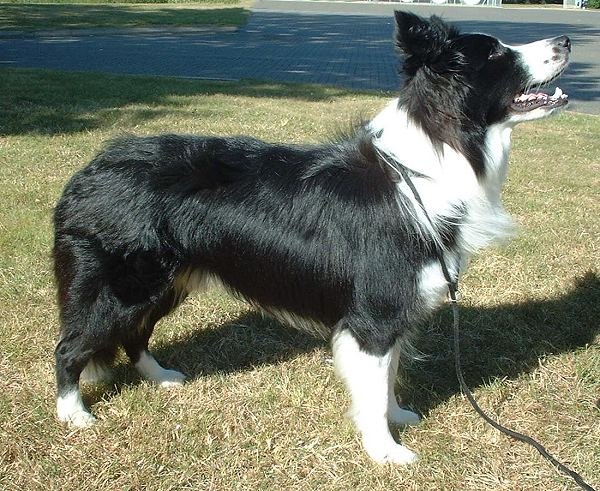
Ranges describe the registry profile, not a measurement, life expectancy, or health prediction for a particular dog. Separate sex or variety ranges are preserved where the source supplies them.
Source characteristics at a glance
The registry uses an ordinal 1–5 scale. A higher number indicates more of the named trait, not a better dog or a compatibility score. These descriptions are general and are not clinical measurements.
History and original work
Developed along the border of England and Scotland, the Border Collie was selected to gather and control livestock across open ground. The characteristic crouch and sustained gaze help explain its style of working sheep. Herding ability and trial work shaped the breed more directly than a single uniform appearance.
Temperament and training
Watch for prolonged staring, stalking, or circling when children, pets, or traffic move. Interrupt early with a practiced alternative rather than letting the dog rehearse herding household members. Reward resting away from activity as well as rapid responses. A dog that learns a trick quickly may also learn unwanted routines quickly; clarity matters more than increasing the difficulty every day.
Daily needs & enrichment
Try controlled searches for a hidden toy, directional exercises, or introductory herding with an instructor who protects both dog and livestock. Agility foundations can develop coordination without repetitive high jumps. Change the task rather than endlessly extending fetch. Teach a recognizable finish so the dog has opportunities to disengage, explore at an easier pace, and sleep.
Coat care
Both smooth and rough coats are double coats. Work through the undercoat and check feathering behind the ears, at the legs, and under the tail; a shorter outer coat does not eliminate shedding. After field activity, look for burrs and grass seeds rather than brushing only the visible surface. Untangle gently before bathing so tight knots are not overlooked.
Use a pin brush once or twice weekly for either coat variety, adding a comb through longer feathering. Daily gentle sessions may be needed during shedding. Rinse baths thoroughly and dry the inner coat; avoid routine shaving, hot drying, and pulling through mats.
Living Environment & Daily Needs
Build a Border Collie's day around meaningful thinking tasks as well as movement. Arrange chances to rest between training and activity; adding walking distance or outdoor space alone may leave important engagement needs unmet.
Care through life stages
Puppies need gradual coordination tasks and rewards for leaving household movement alone. Adults need both meaningful work and a recognizable finish. Adapt tasks and traction for seniors; altered vision, stumbling, or exercise-related weakness needs assessment rather than more encouragement.
Frequently asked questions
Does learning quickly make a Border Collie easy to leave occupied? Not automatically. A dog can learn staring, chasing, and repeated demands as readily as useful tasks. Teach rest and disengagement alongside skills, and plan real care during absences.
Questions to ask before choosing a dog
What does this dog do when another animal runs, when nothing is happening, and when a game stops? Ask for a practical description of life outside the training field, not just competition results. Review the parents' hip, eye, and relevant DNA records and ask directly about collapse or seizures in relatives. Plan outlets for thought without creating a household that is constantly on duty.
Plan care for the individual dog
Budget, time alone and household compatibility depend on the individual dog and your circumstances. Use our care budget guide, time-alone planning guide and questions before adopting alongside the breed-specific source information above.
Health questions for a veterinarian
Request hip evaluations and ophthalmologist reports, plus an explanation of relevant DNA results such as collie eye anomaly and trapped neutrophil syndrome. CEA affects eye development; TNS compromises normal immune defenses. A test for one variant does not replace an eye examination or cover every inherited problem. Border Collie Collapse and epilepsy are important family-history questions because routine DNA panels do not exclude them. If the dog becomes disoriented, weak, or uncoordinated during exercise, stop the activity and seek veterinary advice; collapse has several possible causes and should not be self-diagnosed as a breed trait. Repeated infections or a puppy failing to thrive also require assessment.
Updated October 25, 2026. General information; see our Editorial Policy for sourcing and review practices.