Displayed with responsive cropping.
Ranges describe the registry profile, not a measurement, life expectancy, or health prediction for a particular dog. Separate sex or variety ranges are preserved where the source supplies them.
Source characteristics at a glance
The registry uses an ordinal 1–5 scale. A higher number indicates more of the named trait, not a better dog or a compatibility score. These descriptions are general and are not clinical measurements.
History and original work
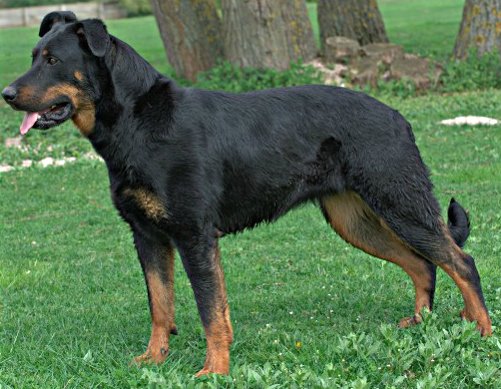
The Beauceron is a French livestock-working dog also known as the Berger de Beauce or Bas Rouge. Nineteenth-century classification distinguished the shorter-coated Beauceron from the longer-coated Briard. Herding, guarding, and later service work contributed to its versatility; its power has always needed to function alongside attention to a handler.
Temperament and training
Teach calm greetings, a release from held objects, and a stop before exuberant jumping or mouthing becomes difficult to manage. Use consistent rewards and clear limits instead of physical confrontations with a sensitive, powerful dog. Introduce visitors and other animals at a manageable distance. Children need supervision and space away from fast play, even when the dog is affectionate with familiar people.
Daily needs & enrichment
Directional obedience, searches, and carefully taught herding or agility foundations can combine movement with decisions. Change locations and tasks without expecting every outing to be harder than the last. Delay demanding pulling or repeated jumping until development and conditioning have been assessed. Include a recognizable finish and a quiet recovery period so participation is not confused with continual arousal.
Coat care
Brush through the short double coat, increasing attention when the undercoat loosens. Inspect the skin and feet after field activity and check every nail, including the rear double dewclaws, which may not wear down through ordinary walking. Teach comfortable paw handling and keep these nails from curling into the skin. A short outer coat can still produce substantial household shedding.
Brush weekly, increasing to daily gentle sessions during heavy shedding, with a medium-bristle brush, mitt, or hound glove. Bathe for dirt and dry the inner coat fully. Avoid harsh scraping and routine body shaving; remember that rear dewclaws may not wear down with walking.
Living Environment & Daily Needs
Plan dependable handling through doorways and household routes for a strong Beauceron. Purposeful exercise and steady, considerate teaching suit the sensitive working dog described here; include regular grooming and a full-sized resting area.
Care through life stages
Puppies need appropriate large-breed growth nutrition, cooperative examination, and calm greetings before strength increases. Progress adult sports with conditioning and recovery. Seniors may need traction and adapted tasks; fainting or unexpected exercise intolerance needs assessment before harder work.
Frequently asked questions
Does walking wear down every Beauceron nail? The rear double dewclaws may not contact the ground. Inspect and maintain them separately so they do not become overgrown or curl toward the skin.
Questions to ask before choosing a dog
Can the household manage this dog's strength during greetings and teach a controlled finish to games? Request the actual hip, eye, and cardiac reports, including the method and date of the heart assessment. Ask about illness in mature relatives and emergency readiness for bloat. Have someone demonstrate nail care that includes the rear double dewclaws.
Plan care for the individual dog
Budget, time alone and household compatibility depend on the individual dog and your circumstances. Use our care budget guide, time-alone planning guide and questions before adopting alongside the breed-specific source information above.
Health questions for a veterinarian
The breed club recommends hip, specialist eye, and cardiac evaluations and notes documented dilated cardiomyopathy without establishing its frequency. DCM affects heart-muscle function and can develop later, so a normal young-dog examination is not a lifetime guarantee. Ask what the cardiac assessment included and whether follow-up is appropriate. Thyroid and elbow evaluations and family orthopedic history may also inform care. The deep chest brings a bloat concern: repeated unsuccessful retching, abdominal enlargement, or sudden distress warrants emergency attention. Persistent lameness, fainting, breathing changes, or unexpected exercise intolerance needs veterinary assessment before demanding work. A DNA panel cannot replace evaluation of joint structure, visible eye disease, or current cardiac function.
Updated October 25, 2026. General information; see our Editorial Policy for sourcing and review practices.