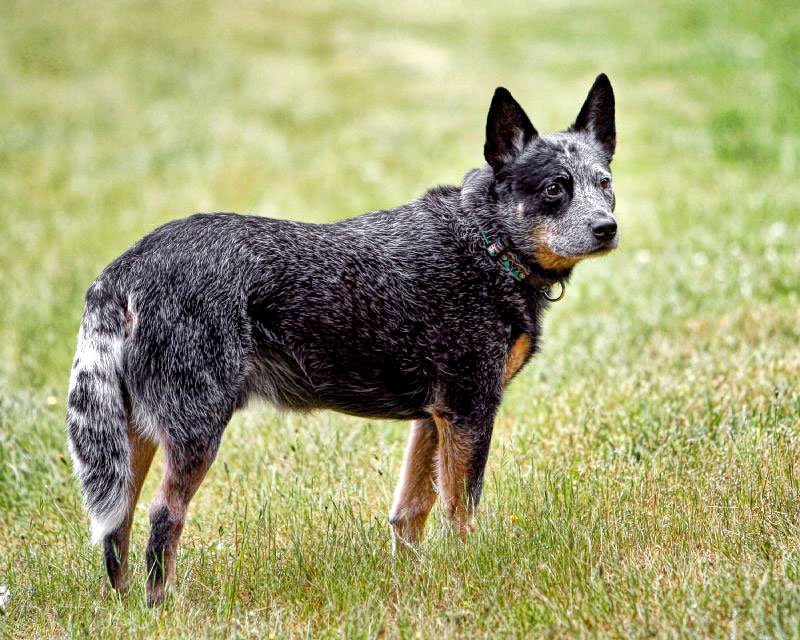
Displayed with responsive cropping.
Ranges describe the registry profile, not a measurement, life expectancy, or health prediction for a particular dog. Separate sex or variety ranges are preserved where the source supplies them.
Source characteristics at a glance
The registry uses an ordinal 1–5 scale. A higher number indicates more of the named trait, not a better dog or a compatibility score. These descriptions are general and are not clinical measurements.
History and original work
The Australian Cattle Dog developed for moving cattle over demanding Australian terrain. Its development involved several working-dog influences, and historical accounts of individual crosses vary. Selection for persistent stock work helps explain its attention to moving feet and its need for more than casual activity; it does not make every dog ready to work livestock without training.
Temperament and training
Reward the dog for leaving moving feet and choosing a hand target or a toy instead. Keep children's running games from becoming herding practice, and teach a calm finish after exciting work. Use clear, reward-based tasks with gradually increasing distractions. Social experience should include neutral behavior around unfamiliar dogs and people, not just high-arousal play.
Daily needs & enrichment
Set up a scent search or a short sequence of retrieve, release and returning to a mat. Give both physical effort and problem-solving a regular place in the week, progressing sports or running with maturity and fitness. Do not keep increasing ball throws when the dog has not learned to stop; recovery is a skill as well as a break.
Coat care
Brush the short double coat to remove loose undercoat, increasing attention during heavier shedding. Check feet after work and feel beneath the outer hairs for skin irritation or embedded debris. The coat is durable but the body beneath it can still be injured. Practice nail care and willing examination before a paw problem interrupts an active routine.
Brush weekly with a short-bristle brush and suitable comb, increasing to every few days during shedding. Bathe occasionally for dirt, rinse fully, and dry comfortably. Avoid harsh scraping or routine shaving, and inspect feet after demanding outings.
Living Environment & Daily Needs
A workable home routine for an Australian Cattle Dog includes purposeful tasks, learning, and active outings. Plan those commitments around its working stamina and leave room for rest; a yard cannot organize mental engagement for you.
Care through life stages
Puppies need safe, gradual activity and rewards for disengaging from moving feet. Adults need conditioned physical work, problem-solving, and a practiced finish. Seniors may need shorter tasks and better footing; stiffness, poor coordination, or sensory changes need investigation.
Frequently asked questions
Will more ball throwing reliably settle a Cattle Dog? Not by itself. Include searching, controlled tasks, a clear end cue, and recovery. Repeatedly increasing arousal can leave the dog practiced at chasing without learning to stop.
Questions to ask before choosing a dog
Can you show BAER results for this puppy, parental joint and eye reports, and separate prcd-PRA and PLL results? Ask to see how the dog stops a game, leaves moving feet and settles. What purposeful work can the household sustain on an ordinary weekday?
Plan care for the individual dog
Budget, time alone and household compatibility depend on the individual dog and your circumstances. Use our care budget guide, time-alone planning guide and questions before adopting alongside the breed-specific source information above.
Health questions for a veterinarian
Australian Cattle Dog club guidance covers hip and elbow assessment, specialist eye examination, BAER hearing testing and distinct DNA tests for prcd-PRA and primary lens luxation. BAER checks hearing; it is not interchangeable with DNA results or a normal ear examination. Ask for the puppy's hearing report and identifiable parental records. New visual difficulty, eye pain or a change in response to sound deserves assessment. An active dog's stiffness or loss of coordination should be investigated rather than explained away as lack of drive or disobedience.
Updated October 25, 2026. General information; see our Editorial Policy for sourcing and review practices.